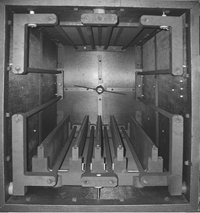
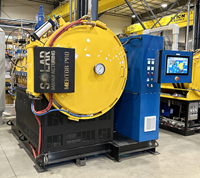
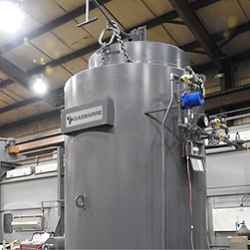
A simple but most effective and very flexible vacuum furnace setup, the single-chamber furnace, consists of one chamber in which the workpiece is both heated (convectively, through vacuum heating) and cooled. Cooling or quenching is accomplished by a closed-loop cooling system.
The pressure vessel is filled with inert gas. This gas is circulated inside the chamber, blowing the inert gas across the workpieces to pick up heat and for further recooling across an internal or external heat exchanger. In order to quench rapidly enough to obtain the desired microstructure of tool steels in various sizes and shapes, it is necessary to increase the pressure and/or flow patterns of the quench gas (usually nitrogen). This is accomplished by high-velocity, high-pressure blowers that have reported cooling gas pressures of up to 20 bar. Turbine powers up to 450 kW are necessary to handle these quenching processes.
For more information, click on the link below (subscription required). Then scroll to Figure 15. R Schneider; R. Mesquita; W Schützenhöfer, Distortion in Tool Steels, ASM International, 2014 https://doi.org/10.31399/asm.hb.v04d.a0005958