To meet the growing demand for metal in the U.S. military—estimated at 750 million tons annually for uses ranging from ship repairs to tank construction—the U.S. Army Research Laboratory is investing millions over five years in advanced manufacturing research. This initiative, led by Hang Yu, associate professor of materials science and engineering, aims to develop faster, more cost-effective alternatives to traditional casting and forging methods through a cooperative agreement supporting cutting-edge innovation.
Central to Yu’s research is a 3D-printing process called additive friction stir deposition (AFSD), which uses friction to reshape high-strength metals like aluminum, steel, and titanium.
Picture rubbing a chunk of Play-Doh between your hands to soften and shape it. AFSD similarly softens a metal stick called a feed rod by pushing it through a spinning tool until friction makes it pliable enough to shape. The plasticized metal is then extruded like toothpaste and spread in layers.
“You can deform material quickly because the stirring itself heats up and softens the material. Then you can deposit it at a very high rate on a large scale,” Yu said. “In additive friction stir deposition, the thermal and mechanical go together. That’s why it’s so efficient.”
Because the metal never fully melts, it’s less prone to defects such as cracking and porosity. Indeed, the friction process has been shown to purify and improve the properties of metal by changing its underlying microstructure, making AFSD a good candidate for upcycling low-quality scrap metal — one of the research avenues Yu’s team will explore.
“The Army has a lot of interest in how you efficiently make use of battlefield steel scrap,” said Yu, the author of a popular textbook “Additive Friction Stir Deposition.” “There would be cost savings and potential benefits to the environment and the supply chain.”
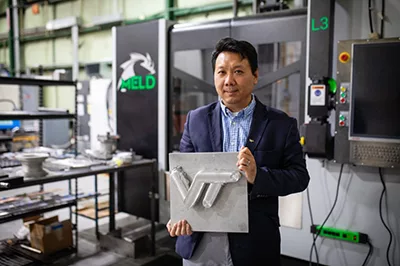
While Yu originally used an AFSD machine produced by Blacksburg-based industry partner MELD, his team has created a smaller, portable version that could make on-site repairs of damaged military equipment.
Beyond defense, AFSD and other advanced manufacturing approaches could have broad applications, including for the auto industry. “Federal research funding is critical to enabling us to advance future manufacturing technologies and the future manufacturing workforce, all of which will be translated to commercial products to improve their performance and our everyday experiences,” said Williams, a leader in advanced manufacturing at Virginia Tech and one of the project’s co-investigators.
Thinking bigger, Yu said AFSD could be an effective way to manufacture metal in space. While traditional metal manufacturing would be hampered by different gravities and environmental impurities on the moon or on Mars, “ASFD is more robust, and you can deploy it in some austere conditions.”
The other collaborators, Yu said, study similar advanced manufacturing technologies or contributing expertise in AI, machine learning, and statistics that will accelerate the research process. “I think that’s the future for advanced manufacturing materials,” he said. “You need an interdisciplinary team to do this work.”
For more information: Virginia Tech
Image: Associate Professor Hang Yu displays a sample of what additive friction stir deposition can create — in this case, a raised VT logo 3D-printed on a metal plate. Behind Yu is the 3D printer developed by Blacksburg-based company MELD. Photo by Peter Means for Virginia Tech.