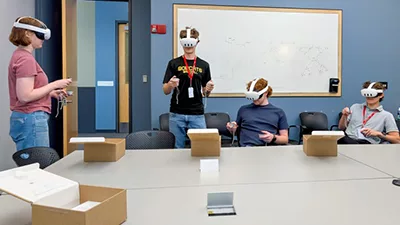
For the first time, the Cornell Nanoscale Science and Technology Facility (CNF) is using virtual reality to inspire and train the next generation of semiconductor professionals. CNF has launched a free VR outreach module that immerses students in its 17,000-square-foot clean room, where microchips are made, using high-definition, 360-degree video accessible via VR headsets, laptops, or tablets. The interactive experience introduces users to chip fabrication and CNF’s expert staff, aiming to address a projected shortage of up to 67,000 skilled semiconductor workers in the U.S. by 2030.
“Cleanroom education is vital for workforce development in the semiconductor industry, yet access to it is hard to come by,” said Judy Cha, professor of materials science and engineering in Cornell Engineering and CNF’s Lester B. Knight Director. “Virtual reality removes these barriers, bringing the clean room to where students are: in classrooms, homes and anywhere in the world.”
The youth outreach module introduces students to topics such as how to put on clean room gowns and the importance of maintaining a contaminant-free environment. People are the primary source of contamination in clean rooms, shedding millions of skin cells per day. Since microdevices are far smaller than a skin cell, clean room suits are essential to contain particles that humans unknowingly emit.
The module is the first of 30 to 40 planned VR training modules that will cover the entire semiconductor fabrication process. These modules will be available nationally in 2027 to universities, community colleges and high schools through a subscription model, which will involve a fee for use to maintain the software and content. Students will access the program via these partner institutions.
CNF spearheaded the training program through a collaboration with Cornell’s Center for Teaching Innovation (CTI) and its Creative Technology Lab, a team of instructional designers and VR developers.
“CTI is committed to leveraging immersive technologies to broaden and deepen the learning experience, and our collaboration with Cornell’s nanoscale facility really showcases the power of VR in education and training,” said Becky Lane, director of CTI’s Creative Technology Lab.
The youth outreach module is part of CNF’s ongoing efforts to build a skilled and diverse microchip workforce, backed by the 2022 CHIPS and Science Act and the U.S. National Science Foundation. “By making nanotechnology and microfabrication more accessible, CNF aims to raise awareness, spark interest among young learners and help maintain U.S. global competitiveness,” said Tom Pennell, CNF’s workforce development program manager.
Separately, Cornell is working with eCornell, the university’s online professional education platform, to develop curriculum for high schools, trade schools, community colleges and universities that lack semiconductor training programs.
And CNF is developing a career-focused public engagement module scheduled for release in fall 2025, backed by Micron Technology Inc., a microchip manufacturer with a presence in Clay, New York.
CNF is also partnering with the Tompkins-Seneca-Tioga Board of Cooperative Educational Services (TST BOCES) to help high school students pursue careers in the industry.
“Every time I work with CNF, I see professionals solving new problems in new ways,” said David Syracuse, New Visions Engineering teacher at TST BOCES. “Exposing students to this kind of thinking shows them not only how to be great scientists or engineers, but how to be good citizens.”
The training program is supported by NSF, the Microelectronics Commons Northeast Regional Defense Technology Hub, the Micron Foundation and Micron Technology Inc.
Funded by NSF and New York state, CNF’s facility is open to other colleges and universities, as well as startups and established companies. It serves roughly 500 users each year.
For more information: Cornell Nanoscale Science and Technology Facility
Image: Interns at Cornell NanoScale Facility use the virtual reality youth outreach module, designed to prepare the next generation of students in cutting-edge microchip fabrication, at Duffield Hall. From left, Elyas Talda, Scott Coonrod ’28, Porter Rowbotham and Nikolas Wheeler.