Researchers from the Department of Energy’s Lawrence Berkeley National Laboratory (Berkeley Lab) have discovered a new way to produce high-entropy alloys (HEAs), at near-room temperatures. Their technique gives users much more control of the alloy’s crystal structure and overall morphology compared with existing methods, opening the door for a new paradigm of custom-made HEAs.
HEAs are made of equal or nearly equal ratios of elements, creating an internal crystal structure with more entropy—meaning it is more disorganized than typical metal alloys. And although this disorganization is key to their function, engineers still need to be able to tune the materials to certain specifications and form them into different shapes.
The existing methods to make HEAs involve heating the elements to high temperatures so that the atoms have a lot of kinetic energy, mixing the different elements into one lump, then rapidly dropping the temperature by various methods. The drastic temperature change is thought to be necessary to lock in a state of internal disorganization from the energetic atoms.
The Berkeley Lab team’s approach, published in Nature, achieves the same high-entropy result at much lower, constant temperatures (a breezy 25–80°C, or 77–186°F) by mixing the elements that will make up the HEA into the metal gallium when it is in liquid form. The elements are introduced in a water-based solution in their chloride forms. When the acidic liquid meets the liquid gallium at a pleasantly warm-to-hot temperature, the elements very quickly shed their chlorine atoms and mix together, then solidify into an HEA alloy.
The new phenomenon was discovered by first author Qiubo Zhang, a postdoctoral researcher in Prof. Haimei Zheng’s group, when he was conducting experiments with the team’s liquid-cell transmission electron microscopy (TEM) platform, a technology they have advanced which allows scientists to study electronic and chemical reactions occurring in liquid environments in real time, at the atomic level. While using a liquid cell TEM to observe liquid gallium, he noticed Cu ions from the CuCl2 aqueous solution were getting sucked into the gallium and forming alloys.
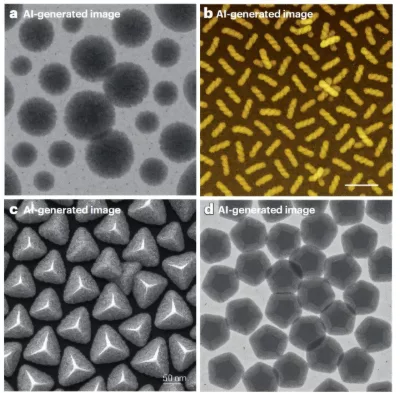
Zhang’s initial efforts to make HEAs with the process yielded nanoparticle-sized amounts. He and his colleagues then worked to scale the approach to make several grams of HEAs at a time. Their current technology, now patented, can generate HEAs in practical shapes other than round particles and with different types of crystal structure. They can also make HEAs with different composite metals, including ones without gallium, though that element is still key to the process.
Zheng group is now collaborating with Kristin Persson, director of the multi-institutional Materials Project, Berkeley Lab faculty senior scientist, and Daniel M. Tellep, Distinguished Professor in Engineering at UC Berkeley, to accelerate the design of new HEAs using artificial intelligence. These breakthroughs will help move HEAs from promising experimental applications to real-world products.
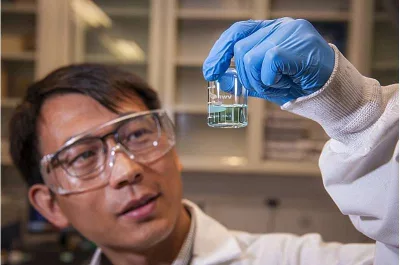
Image – First author Qiubo Zhang examines a sample of high-entropy alloy in solution produced using the team’s new technique. Courtesy of Robinson Kuntz/Berkeley Lab.
************
For more information:
Lawrence Berkeley National Laboratory