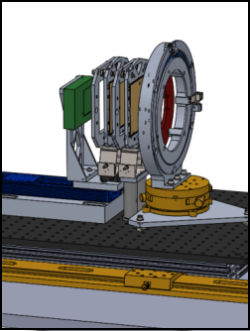
Designing hypersonic aircraft that travel at five to seven times the speed of sound is a major challenge because their materials must be lightweight yet capable of withstanding extreme heat and pressure. To address this, researchers at Embry-Riddle Aeronautical University, in collaboration with the U.S. Department of Energy’s Argonne National Laboratory, are developing a device that simulates the intense thermal and mechanical stresses of hypersonic flight. Paired with the ultrabright X-rays of Argonne’s Advanced Photon Source, this system will allow scientists to observe real-time changes in these materials under flight-like conditions.
“Recreating the environment of hypersonic flight can be complicated,” said Seetha Raghavan, professor of aerospace engineering and a co-principal investigator on the project. “There are so many factors and no perfect way to test them all. High enthalpy wind tunnels that can simulate the wind speed use a lot of energy resources and are limited in access.” (Enthalpy refers to the heat content of a system at constant pressure.)
The research team’s goal is an alternative that replicates hypersonic flight conditions using fewer energy resources and uses APS X-rays to capture detailed data. The APS is in the final stages of an upgrade that increased the brightness of its X-ray beams by up to 500 times. It is now the brightest synchrotron X-ray facility in the world, and according to Raghavan, the enhanced capabilities of the upgraded APS are crucial to this project.
“When you are talking about hypersonics, you’re talking about high speeds and fast changes, and response time is critical,” she said. “You can only get that kind of time resolution with enough flux (or brightness of the beam), and the upgraded APS is able to help with that.
“Additionally, the materials we’ll be testing are the thinnest that can be used, and at the upgraded APS you can focus the beam down to a small enough size to capture the data we need,” she said.
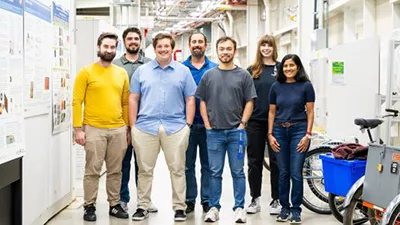
Victoria Cooley, an APS beamline scientist who worked with the Embry-Riddle team at beamline 1-ID, touted both the upgraded X-ray beam and the improved experiment station.
“It’s an exciting time for our beamline,” she said. “Brighter X-rays allow us to probe deep into materials with a higher-resolution beam and map very thin samples like these. At the same time, we have installed faster, more sensitive detectors to capture chemical or crystallographic changes occurring incredibly quickly. These two pieces come together to make world-changing projects such as this one possible.”
Uncovering materials that can withstand the conditions of hypersonic flight and are not prohibitively expensive to produce is key to unlocking their many applications. Durable hypersonic materials could be used for military and civilian aircraft, as well as cargo delivery vehicles.
The hypersonic materials project is supported by a $1.4 million contract from the U.S. Department of War Joint Hypersonics Transition Office through the University Consortium for Applied Hypersonics. The Embry-Riddle team’s principal investigator is William Engblom, professor of aerospace engineering, and Mark Ricklick, associate professor of aerospace engineering, is a co-principal investigator.
For more information: Embry-Riddle
Image: The Embry-Riddle research team at Beamline 1-ID, with Argonne scientist Victoria Cooley (back row, right). (Image by Mark Lopez/Argonne National Laboratory.)