Researchers at the University of Strathclyde in Glasgow, U.K., have shown that consumer-grade 3D printers and low-cost materials can be used to produce multi-element optical components that enable super-resolution imaging, with each lens costing less than $1 to produce. The new fabrication approach could broaden access to fully customizable optical parts and enable completely new types of imaging tools.
The researchers innovative lens design and manufacturing processes combine 3D printing, silicone molding, and a UV curable clear resin. Their goal was to make inexpensive lenses that could be used in a multifocal structured illumination microscope (SIM). This type of microscope uses patterned light at multiple focal points to illuminate a sample, capturing multiple images that are computationally combined to reveal details smaller than the normal diffraction limit.
To invent a high-quality lens for microscopy, the researchers needed to figure out a way to reduce the optical scattering they observed when focusing a laser through a 3D-printed lens. This scattering occurs because the lens is printed layer-by-layer using a pixelated screen, which can lead to unwanted diffraction effects in the lens. Thus, they developed a molding method to help eliminate this problem.
The new fabrication approach begins with a typical 3D printing process that involves designing the optic in freely available CAD software and then using a 3D printer to fabricate the design. After some simple processing steps, this produces a 3D printed raw optic.
To enhance the clarity and transparency of the lens, the team then attached more of the 3D printing material to each lens surface to smooth out the thin layers produced by 3D printing. This additive approach, which is much quicker than the traditional approach of polishing, created a custom-designed lens with surfaces smooth enough to compete with commercial-grade glass lenses.
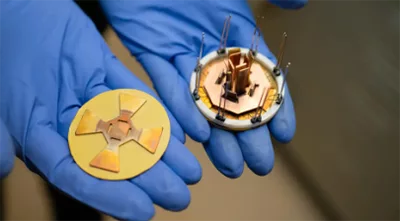
For the multifocal structured illumination microscope, they designed and printed a lenslet array, which is a single optic consisting of many small lenses on the same surface. This optical design makes it possible to create many illumination points in the microscope, speeding the ability to capture tiny details in samples.
After printing and refining the lenslet array, the researchers made a silicone mold of it which they then filled with inexpensive UV-curable clear resin. This created an optical part that didn’t suffer from diffraction effects.
The team used precision surface measurements to compare their low-cost optics against high-end and budget commercial optics, finding that the 3D-printed lens surfaces matched well with both types of commercial optic surfaces. They then used the 3D printed optical lens array in their lab-prototype multifocal structured illumination microscope, observing super-resolution biological data that was nearly identical in quality to that acquired with commercial glass lens arrays.
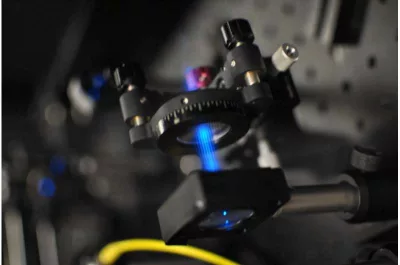
Image – Researchers fabricated an inexpensive lenslet array for super-resolution imaging in a multifocal structured illumination microscope. The individual lenslet laser beams are shown here. Courtesy of Ralf Bauer/University of Strathclyde.
************
For more information:
University of Strathclyde