Instead of reinventing the wheel, the goal of one University of British Columbia (UBC) researcher at the Okanagan campus is to make wheels, and other manufactured materials, lighter, stronger, and safer. Once the domain of science fiction, the recently installed 3D x-ray computed tomography (CT) microscope is allowing experts to peer inside the internal structure of materials and explore a 3D image, magnified 1,000 times. It’s the first step towards lighter and stronger resources that can be used in most industries including aerospace, energy, and manufacturing, says UBC School of Engineering Assist. Prof. André Phillion.
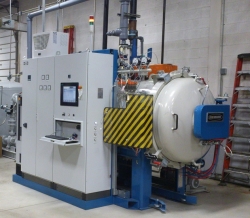
The leading-edge technology—this is B.C.’s first high-resolution CT scanner, and one of only five in Canada—provides highly-magnified, internal pictures that can be examined in great detail. For those in the manufacturing industry, this opens the window to determine how defects can form and how they can lead to failure. Phillion uses the basic aluminum alloy automobile wheel as an example.
“We know that stress causes fatigue and we know how metals respond to stress,” Phillion says. “What we’re asking is, ‘Can we predict a potential flaw in the wheel and then eliminate potential danger?’ “
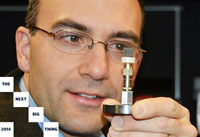
Phillion says UBC’s machine is different than the CT scanners found in most hospitals, since the magnification is much greater. He is not aware of anyone in Canada using this technique to study manufacturing. In UBC’s lab, investigators can take a sample about the size of a pinkie finger and magnify it more than 1,000 times its original size to reveal the internal structure of the material. Defects then become visible.
The research not only improves manufacturing processes, like the casting of aluminum alloys for wheels, but also enhances performance and, ultimately, the lifetime of the component.
“We are currently looking at a wide range of materials—metals, composites, paper-based products—and trying to decipher images that are enormously complex,” Phillion says. “The end goal is to make products that are lighter and have fewer defects, and to also find new uses for traditional materials.”
In the future, one could imagine a world where metal castings are designed so that areas prone to deficiencies are thicker, while areas that are defect-free are thinner, to reduce weight, says Phillion. We may be able to use recycled aluminum alloys in aerospace applications to reduce costs, or maybe design a hydrogen fuel cell that operates more efficiently.
Image – André Phillion
More information: