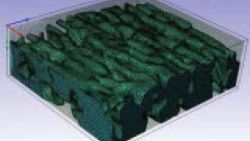
Researchers at Aalto University in Finland have developed a beta-tricalcium phosphate surface treatment for porous orthopedic and dental implants that will help reduce the risk of infection. Porosity is important for implants, because it helps to ensure good contact between the implant and the bone. However, it also allows bacteria to adhere and grow, leading to increased risk of infection.
A thin coating of hydroxyapatite (HAP) or bioactive glass (BAG) is typically applied to orthopedic and other implants to alter the surface properties. Such coatings improve the body’s ability to recognize a foreign object in a more friendly way and promote implant integration into surrounding tissues. However, during the heat treatment process, excessive stresses can cause premature cracking and removal of the coating layer. This can lead to the development of deleterious compounds and increase the risk of infection.
“Our work has focused on developing an analysis of surface treatments for commercial implants which reduces risk of infection,” said Professor Michael Gasik. “We have proven that by adding a certain amount of beta-tricalcium phosphate (ß-TCP) such stresses are reduced and the biomaterial coating is better preserved.” This minimizes the risk of coating destruction and bacterial adhesion, and allows the implant surface to achieve its function in an optimal way.
“Normally, implants require a certain level of porosity and elasticity to function properly,” added Professor Gasik. “The challenge for us was to ensure full functionality of the implant while maintaining sufficient density of the coating during the heat treatment process.”