Work from Helmholtz-Zentrum Berlin für Materialien and Energie (HZB), and University of Münster, both in Germany, shows how new phases in a nickel-based alloy form and evolve, providing clues to how high-performance alloys could be improved. Researchers combined transmission electron microscopy (TEM) and atom probe tomography (APT) to accomplish this. The microstructure of nickel-base alloys changes under controlled aging or heat treatment and in the classical two-phase microstructure new phases are initially formed. Researchers precisely observed the phase separation process on the atomic scale for the first time.
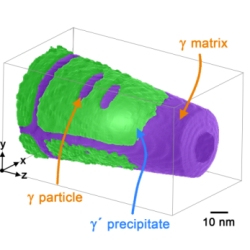
To do so, they simulated the aging process of the alloy by heat treating it for different periods. They documented how the microstructure changed during aging by using micrographs from the TEM. Whereas the classical two-phase microstructure consists of cuboid γ’ precipitates embedded in a so called γ-matrix, during heat treatment, spherical γ particles initially form in the γ’ precipitates of the alloy, and then further coalesce into plates that finally split the γ’ precipitates. The thermo-mechanical properties of these types of alloys depend largely on the stability of this γ/γ´ microstructure. www.helmholtz-berlin.de/index_en.html.
Image caption – 3D reconstruction of an atom probe measurement. The γ matrix (purple) is surrounding the cuboidal γ’ precipitates (green). Only a few nanometer-sized γ platelets are seen in the γ’ precipitates. APT allows site-specific analysis of the structure at the atomic scale and reveals the chemical composition in measurements of individual areas. Courtesy of HZB.