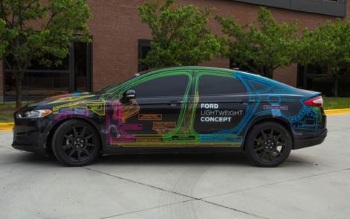
With the automotive industry focused on hitting future fuel economy and emission targets, the Ford Motor Co., Dearborn, Mich., revealed a drivable multi-material lightweight vehicle (MMLV) with an advanced polycarbonate (PC) glazing solution from SABIC’s Innovative Plastics business that reduces weight by 35% compared to the same window on a 2013 model year Ford Fusion. The weight savings total 7.4 lb, even though the rear window is < 1 mm thicker than the production glass window it replaces.
The lightweight concept vehicle was developed with the U.S. Department of Energy’s Vehicle Technologies Program, together with Cosma International—a subsidiary of Magna International, Toronto—to illustrate long-term potential light-weighting solutions. SABIC contributed PC glazing materials, advanced coatings technology, and engineering design expertise to support the rear window’s development and production.
The advanced PC solution used in the concept’s rear window combines LEXAN resin, a PC material characterized by its light weight, high optical clarity and impact resistance, with EXATEC E900 plasma coating for glass-like scratch and UV resistance. The coating is designed to deliver a high level of weatherability and abrasion resistance over the life of the vehicle and enable automakers to meet homologation requirements for driver visibility—including U.S. standards such as the Federal Motor Vehicle Safety Standard (FMVSS) 205 regulations, as governed by the NHTSA AS2 specification, and the American National Standards Institute Z26.1, which covers the visibility, strength and abrasion resistance of glazing materials.
The potential for big weight-savings led Ford to produce the window out of PC material, which is half the density of glass. With this PC-based rear window, Ford now has another platform upon which to test the overall performance of this lightweight technology, which is consistent with its continued efforts to determine the right mix of materials and applications for future vehicles.
Additional weight reduction benefits
SABIC has determined that weight reduction benefits from the use of PC glazing can contribute to the sustainability of a vehicle by improving energy efficiency and reducing emissions. This boost in energy efficiency can come not only from weight reduction, but also from improved thermal insulation of the passenger cabin, a result of PC’s five-fold lower thermal conductivity relative to glass. Advanced computer analyses have quantified LEXAN resin’s potential to reduce the load on HVAC systems: emissions can be cut by as much as three grams of carbon dioxide per kilometer, and the range of electric and hybrid vehicles can be extended by 2-3%.
Design flexibility
The rear window of Ford’s MMLV is identical in geometry to the part used in the Fusion production vehicle. This design approach allows Ford to test the two parts and compare the performance differences between them based strictly on the change in materials.
The material’s ability to be injection molded means windows can be designed to reduce even more weight, increase aerodynamic performance and enhance styling. Designs can go beyond the shape and complexity limitations of glass to glazing with geometric effects that can make possible relatively thin PC surfaces, potentially adding to the weight-out total. Also, 3D styling possibilities and aerodynamic features enabled by PC glazing can minimize drag and contribute to fuel efficiency.
Integration opportunities, enabled by PC glazing, can also contribute to enhanced efficiency – and cost savings – by reducing the number of parts and materials associated with joining otherwise discrete components.
Large scale plasma coating production
Another consideration for automotive OEMs and suppliers is the maturity of PC glazing technology and its suitability for mass production. In collaboration with ULVAC, a leading global supplier of mass production systems, SABIC has helped develop an advanced vacuum equipment technology for the automotive industry to develop lightweight, plasma-coated PC glazing components cost-effectively and efficiently on a broad scale.
In addition to PC glazing, SABIC offers thermoplastic solutions for almost every major application space on a vehicle. In the 2013 model year Ford Fusion, for example, about 20 kilograms of SABIC resins are used to reduce weight and meet diverse performance requirements for chassis, forward lighting, interior and structural, exterior, electrical and underhood applications.