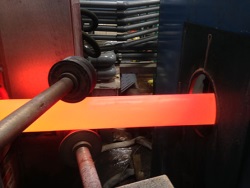
The Center for Heat Treating Excellence, Worcester Polytechnic Institute, Mass., is working on a research project to test the benefits and limitations of induction tempering versus furnace tempering. The goal is to develop a fundamental understanding of the induction tempering process in terms of the effects of power and frequency on the microstructure and properties of the part. Results will enable companies to decide on the optimal technology required to reduce cycle time and process costs while maintaining or improving product quality.
The expectation is that CHTE members will be able to eliminate trial-and-error experimentation and apply the data to process designs, thus improving efficiency and productivity. The project will provide information on the best recipe to maximize the performance of parts.
A detailed comparison will be made between parts that are tempered using the “less than optimum” parameters from induction heating equipment designed for annealing. In addition, a comparison of the microstructures, residual stress distribution, and mechanical properties (hardness, impact toughness, and torsional properties) of several induction-tempered steels with furnace-tempered steels will be made.
At this point, the furnace tempering experiments have been completed.
It was found that the hardness could be predicted with the Hollomon-Jaffe relationship with a constant of C=14 for AISI1045 and C=13 for AISI4140.
Preliminary experiments to determine the effect of phase transformations during heating were completed. It was found that the tempering process had begun during the first 20 minutes of the heat-up to the tempering process.
Induction tempering experiments at Thermotool will be completed in May or June.
Detailed metallographic analysis will be conducted to compare furnace and induction heating.
http://wp.wpi.edu/chte/project-portfolio/induction-tempering/