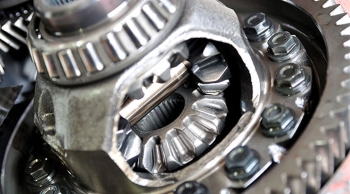
Casting parts from molten iron is a well-established process that has been transformed recently by technological advances. LIFT, Lightweight Innovations for Tomorrow, has chosen to investigate those innovations in melt processing as its first technology acceleration project. Grede Holdings, Southfield, Mi., and Michigan Technological University, Houghton, are the lead industry and research partners on the project, which will focus on reducing the amount of metal used in making an automotive transmission differential case.
“People don’t often think of iron alloys as lightweight, so this first project shows how we are really changing the thinking about manufacturing in America,” says Larry Brown, executive director of LIFT. “We expect that by working together through LIFT, collaborators will be able to accelerate the speed of turning their R&D into a production line process.”
By integrating and implementing improved manufacturing methods with different available alloys, there is potential to decrease the wall thicknesses of ductile iron cast parts by up to 50%. That, in turn could save from 30-50% weight savings, depending on the load requirements of the part.
Jay Solomond, vice president of engineering and technology at Grede notes, “During early product development, parts are designed to meet the limiting performance criteria. This often results in parts being globally designed with extra material to meet the minimum requirements. However, this also often results in unnecessary weight to the overall part. We want to put the right amount of material just where it needs to be—and to replicate that on a scale for automotive production lines.” Grede expects to do a significant amount of work on the project in its St. Cloud, Minn., foundry.
Associate professor of Materials Science and Engineering at Michigan Tech, Paul Sanders, says, “Iron alloys have high stiffness and good strength. We will optimize composition and cooling rate using Grede’s new high precision molding machines to create thin-wall ductile iron components while maintaining desired microstructures and performance. We look forward to integrating upfront modeling with local cast properties to design optimized component geometries. We hope to bring this lightweight design methodology into production.”
LIFT is one of six manufacturing innovation institutes announced to date and supported by the federal government. LIFT receives its funding from the U.S. Department of Defense administered by the U.S. Navy Office of Naval Research. Approximately 44% of the estimated $1.34 million costs for this melt processing technology acceleration project will be paid for by the federal government, the other 56% will be shared by industry and research partners.
“We expect to be seeing results from this first project in about a year. And with nearly 90 industry and academic partners in our consortium, we expect to be announcing more technology projects on a regular schedule, as well as important education and workforce development initiatives to make sure we have people well trained in the innovations we are generating,” says Brown.