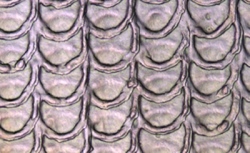
Researchers at the Karlsruhe Institute of Technology, Germany, have reportedly succeeded in reducing friction on steel parts by as much as 40% by etching surface patterns resembling those on the skin of reptiles. Christian Greiner and Michael Schäfer used laser surface texturing to etch oval-shaped, 50-μm long patterns on flat steel surfaces. They believe the work could help to minimize friction in tiny mechanical devices where lubricants cannot be used.
On certain reptiles, the scales protrude about 5 μm from the surface and overlap each other to form columns. In one pattern, the columns are isolated from each other, whereas in the other pattern, the columns overlap each other. After etching, the similarly patterned steel surfaces were slid across a smooth, dry sapphire surface at a constant speed of 0.1 m/s and a downward force of 2 N. Compared with a smooth steel surface, the isolated columns had 40% lower friction, whereas the overlapping columns had a 22% reduction.
The researchers think that their discovery could help to reduce friction in machines that cannot be lubricated, such as nanometer- and micron-sized devices in which lubricants tend to gum up moving parts, rather than help them move. Potential applications include reducing friction in the sensors in anti-lock braking systems, computer hard-disk drives, accelerometers in mobile phones, and machines that operate under vacuum conditions.
Unlike reptile skin, which has low friction when moving in only one direction, the new textured surfaces have reduced friction in at least two directions. Surfaces with unidirectional friction reduction could be used to create snake-inspired robots that would be useful for exploring extremely dusty environments on Earth or even in space. Dr. Greiner is currently trying to develop textured polymer surfaces that mimic the unidirectional nature of reptile skin.