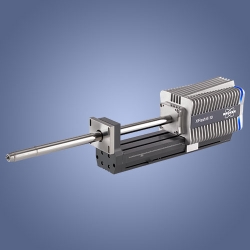
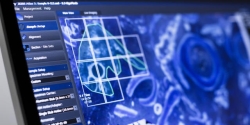
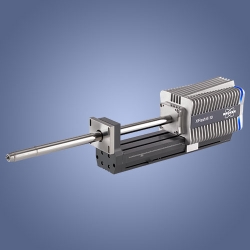
Bruker Nano Analytics, Madison, Wis., has developed XFlash FlatQuad, a side-entry silicon drift detector positioned between the SEM pole piece and sample. The primary electron beam can pass through the center hole around which the four detector segments are arranged. The solid angle for radiation collection that can be achieved depends on the distance between detector and sample. It can be varied by using the Z drive of the SEM stage. A set of included electron absorbing polymer windows can be changed in situ.
Nondestructive sample analysis with high spatial resolution can be very difficult using conventional EDS detectors as sample surface charging. Electron beam damage and shadowing effects by topography are common problems in scanning electron microscopy. The XFlash FlatQuad silicon drift detector (SDD) overcomes these limitations. The special geometry with an annular arrangement of detector elements offers a very high solid angle and allows the use of ultra-low-beam currents and the investigation of samples with complex topography.
Shadowing effects are minimized by collecting X-rays from four separate detector segments with high take-off angles. Additionally, the large solid angle of up to 1.1 sr enables EDS analysis with reasonable count rates using ultra-low beam currents of <10 pA.
As a result, the charging of nonconductive samples under high vacuum is minimized. This approach therefore enables non-destructive EDS analysis of sensitive topographic samples, because sample preparation such as polishing and carbon coating is not required.