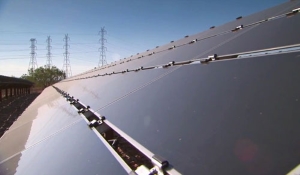
Solar cells integrated into new construction, particularly skyscrapers, are an enticing energy option. However, this effort can be hampered by the cost and architectural considerations sometimes needed to mount traditional photovoltaic (PV) cells.
What if engineers could make it easier with a lightweight, clear and flexible solar cell? Traditional solar panels, such as silicon, soak up much of the sun’s light, including visible light, and convert it to energy. A transparent panel allows visible light to shine through, by making the light we can’t see with our eyes—such as ultraviolet and infrared—do the work.
With support from the National Science Foundation (NSF), Michigan State University, East Lansing, materials scientist and chemical engineer Richard Lunt and his team are developing transparent solar panels that could be retrofit to cover existing windows instead of replacing them. With the square footage of glass that’s on skyscrapers and other buildings, the tremendous potential for energy and cost savings is clear.
The research in this episode was supported by NSF Faculty Early Career Development (CAREER) award #1254662, Optical and Nanostructural Control of Visibly Transparent Small-Bandgap Excitonic Semiconductors for Integration in Highly-Efficient Transparent Photovoltaics.
Image caption — Engineers at MSU are designing new transparent solar panels that could be retrofit to existing glass-covered buildings.