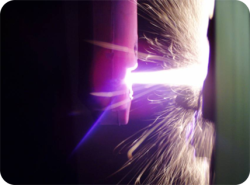
Flame Spray Industries, Port Washington, N.Y., reports that its plasma transfer wire arc technology is being used on the latest Shelby engine to produce a thin, strong surface layer that provides excellent cylinder wall oiling and durability. The process utilizes a single wire as the feedstock material, including cored wires. The wire is melted, atomized, and propelled to the substrate by a supersonic plasma jet that is formed by a transferred arc between a non-consumable cathode and the tip of the wire.
After initial atomization, a large flow of forced air through the nozzle transports the stream of molten droplets onto the bore wall. The high kinetic energy causes the particles to flatten when they impinge on the surface of the substrate; the heat transfer between the flattened particles and the substrate causes a rapid solidification. Thus the coating is made up of these solidified droplets stacked one on top of another along the surface.
The system is designed for easy start-stop operation, can be hand held or machine mounted and may be operated for up to 100 hours continuously without changing components. The PTWA process uses one wire, which makes it ideal for stable, trouble-free solid and cored wire applications. In general, PTWA is used to repair corroded or worn parts, to improve part life by adding a wear-resistant coating, to apply a coating to irregular surfaces, and to reduce part cost.
Recently, engine manufacturers and remanufacturers as well as automotive companies have turned to PTWA to apply a wear resistant coating on the internal surface of engine block cylinder bores. For hypoeutectic aluminum silicon alloy blocks, PTWA provides a lower cost and lower weight alternative to cast iron liners, while delivering increased displacement in the same size engine package and a potential for better heat transfer.