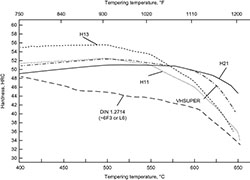
The ability of a given grade of hot-work tool steel to maintain hardness for a prolonged time at high temperatures is called tempering resistance. A simple comparison of tempering resistance may be performed by analyzing tempering curves such as those shown in the graph. Higher tempering resistance is related to curves dislocated to the right. High mechanical strength at high temperature is fundamental for hot-work steels.
Toughness in hot-work tools is an essential property for avoiding the cracks and fractures that can be common in normal working conditions. Unexpected and very unstable in cold-work tools, cracks may be encountered after a given operation time for hot-work dies. The most important example is fine crack networks, large in number but small in length, observed on a tool surface after the tooling operation. This kind of cracking is known as heat checking and is typically found in die-casting dies as well as in forging dies or other hot-work tools. The cause is thermal fatigue at the tool surface, caused in turn by repeated temperature fluctuations (heating and cooling) during tool operation.
Depending on the intensity, heat checking can lead to tool failure, which is typically the case in die-casting cavities. In such situations, the casting metal, normally aluminum, enters into the heat-checking cracks, making part extractions difficult or impairing part surface quality. In cases of a lack of toughness, gross cracking may also occur, leading to complete loss of the working tool.
Volume 4D, Heat Treating of Irons and Steels -> Tool Steels -> Heat Treating of Hot-Work Tool Steels-> Introduction