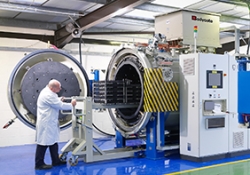
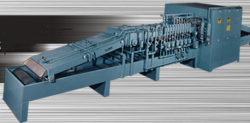
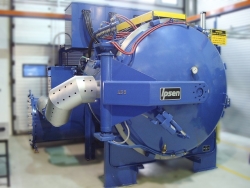
Bodycote, England, held a ground breaking ceremony in February for a new aluminum solution treatment capability at its location in Westminster, California. With this new capability, Bodycote will be able to process aluminum alloy structures up to 21 feet in length at 1100°F, in multiple types of quench media. This new furnace, scheduled to be in service by the end of third quarter this year, will allow the treatment of large aerospace and commercial forgings weighing up to 20,000 pounds.
The mechanical properties of heat treatable aluminum alloy components can be optimized by the selection of an appropriate solution and age process sequence. For certain alloys, corrosion resistance can, for example, be improved at the expense of strength and vice versa.
Depending on the alloy and cross section at the time of solution treatment, various cooling methods can potentially be utilized to reduce distortion.
Solution treating is typically performed in the 842 to 1067°F range in air, followed by rapid quenching into cold water, hot water, boiling water (-T61 temper), water-polymer (glycol) solution, water spray, or forced air. Natural aging to the T4 temper will occur at ambient temperature for 2XXX, 6XXX, 2XX and 3XX alloys, with most reaching a stable temper after 96 hours. Artificial aging in the 199 to 473°F range is utilized to meet the T6 and T7X tempers.
Immediately after quenching from solution treating, all alloys are relatively soft and can be moderately formed or straightened if performed within a couple of hours. These alloys will naturally age harden at ambient temperature, with their hardness gradually increasing with time following quenching. This can be suppressed by refrigeration below about 0°C (32°F) if it is desired to form or straighten the material more than a couple of hours after quench. Cooling to below about minus 23°C (minus 10°F) or colder is required to retain the As-Quenched (AQ) temper for prolonged storage times beyond a few days.
For maximum formability prior to solution treating and ageing, these alloys must be fully annealed to produce a stable dead soft O temper by heating in the 400 to 425°C (752 to 797°F) range, then slow cooling (28°C or 50°F per hour or slower) to below 235°C (455°F), formed, then solution is treated and aged.
Wrought alloys in the 2XXX (Al-Cu), 6XXX (Al-Mg-Si), 7XXX (Al-Zn-Mg-Cr) and 8XXX (Al-Li) series and cast alloys in the 2XX (Al-Cu), 3XX (Al-Mg-Si-Cu) and 7XX (Al-Zn) series can be solution treated and aged.
Bodycote continues to invest in regional aerospace manufacturing markets across the United States in support of aerospace prime manufacturers and their supply chains.