DC Plasma Arc Gun
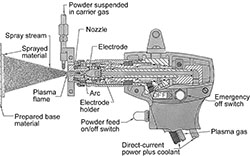
The basic components and design of a dc plasma arc gun are illustrated in this cross-section of an external injection plasma spray gun. (Diagram courtesy of Sulzer Metco.)
Direct-current plasma arc guns combine an axially aligned cathode (typically, 1 to 2% thoriated tungsten), an anode/nozzle (typically, oxygen-free high-conductivity copper), and some means to control gas-flow geometry in the arc chamber.
Tungsten is used as a cathode for two reasons: first, it has a high melting point (6192°F); second, it is a good thermionic emitter, readily releasing electrons to maintain the arc discharge. Typically, the thoriated or ceriated tungsten tip operates at or near its melting point, due to high electron current densities, which locally heat the cathode tip.
Cathodes rely on conduction and the high melting point of tungsten to survive the high-temperature arc because they are indirectly water cooled. A water-cooled, copper anode/nozzle constricts and spatially stabilizes the arc and accelerates the expanding, heated gases. Plasma-forming gases are introduced through the rear of the gun.
Typically, these gases enter the arc chamber through a gas ring (gas injector) that imparts a spin or vortex flow to the gas. The vortex stabilizes the arc at the cathode tip in the low-pressure region of the vortex and rotates the arc attachment or arc root at the anode. This is called vortex stabilization. Rotation of the anode arc attachment minimizes arc erosion of the anode.
Volume 5A, Thermal Spray Technology ⇒Thermal Spray Processes and Coatings ⇒ Thermal Spray Processes