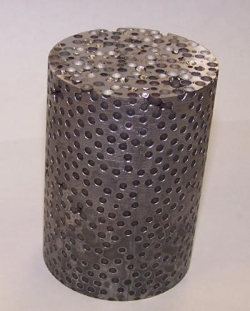
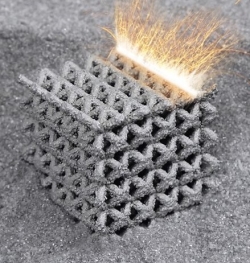
North Carolina State University, Raleigh, reports that novel lightweight composite metal foams made of materials such as steel spheres embedded in aluminum are more effective at insulating against heat than solid conventional metals such as steel. The composite metal foam consists of metallic hollow spheres — made of materials such as carbon steel, stainless steel or titanium — embedded in a metallic matrix made of steel, aluminum, or other metallic alloy. These foams are especially promising for storing and transporting nuclear material, hazardous materials, explosives, and other heat-sensitive materials, as well as for space exploration.
“We have developed two technologies for manufacturing composite metal foams (CMF),” says Afsaneh Rabiei, a professor of mechanical and aerospace engineering at NC State and corresponding author of a paper on the work. “One is based on casting a low melting point matrix material, such as aluminum, around hollow spheres made of a material with a higher melting point, such as steel. This creates aluminum-steel CMFs, for example. The other technique is based on sintering the matrix powder around prefabricated hollow spheres. This creates CMFs such as steel-steel, which consist of steel hollow spheres in a steel matrix.”
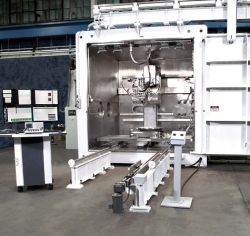
In one test, researchers exposed samples of 2.5 by 2.5-inch steel-steel CMF that were 0.75 inches thick to a fire with an average flame temperature of 800°C for a period of 30 minutes on one side, and monitored the material to see how long it would take for the heat to reach the opposite side of the sample.
For a piece of bulk stainless steel with the same dimensions as the CMF sample, it took only four minutes to reach 800°C, but it took eight minutes for the steel-steel CMF to reach the same temperature.
“We already knew the CMFs have outstanding high-velocity impact resistance, and effective radiation shielding. Now we know that it can withstand high heat,” Prof. Rabiei says.
The researchers also found that the composite metal foam made entirely of stainless steel expands 80% less than bulk stainless steel at 200°C — and the differential increases at higher temperatures. Another noteworthy advantage is that the composite metal foam expands at a fairly constant rate when exposed to high heat — whereas conventional bulk metals and alloys such as stainless steel expand more rapidly as temperature increases.