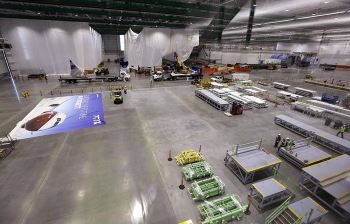
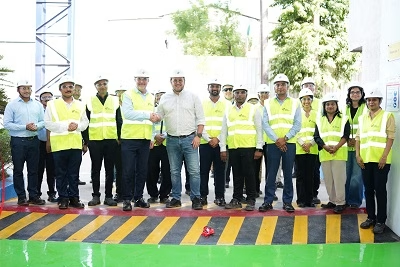
Employees at the Boeing Co. recently celebrated the grand opening of the new 777X Composite Wing Center (CWC) in Everett, Wash. The facility, located on the north side of the main final assembly building, will manufacture the world’s largest composite wings for the 777X, the company’s newest commercial jetliner, and sustain thousands of Puget Sound area jobs. Boeing has invested more than $1 billion in the site for construction and outfitting of the new building.
Construction of the new CWC building required approximately 4.2 million hours of construction time. At its peak, 1700 contract employees worked on the project. By the numbers, the new building required:
- 31,000 tons of steel with the highest beams weighing 720 pounds (326.587 kilograms) per foot.
- 480 miles of electrical cable.
- 80,000 linear feet of process piping.
- 170,000 cubic yards of concrete were poured. The concrete was brought to the site by more than 16,500 truckload deliveries.
The CWC is more than 27 acres under one roof—the equivalent to 24 football fields and the building will contain three of the world’s largest autoclaves—each big enough to fit two Boeing 737 fuselages inside. The 777X aircraft advances the world’s most efficient twin-aisle family of airplanes. Two models will comprise the 777X family—the 777-8X, with approximately 350 seats and a range capability of more than 9300 nautical miles; and the 777-9X, with approximately 400 seats and a range of more than 8200 nautical miles.
The 777-8X competes directly with the Airbus A350-1000, while the 777-9X is in a class by itself, serving a market segment that no other airplane can. To date, the 777X has accumulated 320 orders and commitments from six customers worldwide. Production of the 777X is scheduled to begin in 2017, with first delivery targeted in 2020.
Image caption — The Boeing Co. opened a new 777X Composite Wing Center which will contain three of the world’s largest autoclaves—each big enough to fit two Boeing 737 fuselages inside. Courtesy of AP Photo/Elaine Thompson.