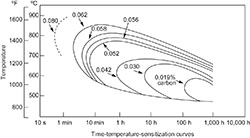
The lower carbon content in an austenitic stainless steel slows the kinetics of carbide precipitation. This allows longer time at temperature before the onset of sensitization. The graph shows the Time-Temperature-Sensitization diagram (TTS) for 304 austenitic stainless steel with various amounts of carbon. Decreasing carbon content significantly delays the formation of chromium carbides and the onset of intergranular corrosion. In low-carbon grades, defined as those with carbon content below 0.030%, an exposure of about 8 hours is necessary before sensitization occurs
Carbon content of 0.03% and lower allows short excursions of several hours into the sensitizing temperature range without loss of corrosion resistance. Carbon in austenite can be retained in supersaturation for extended periods of time. This is why austenitic L grades do not sensitize even though they are slightly supersaturated. Sensitization occurs at higher levels of carbon by prolonged heating at 600 to 850°C.
Volume 4D, Heat Treating of Irons and Steels ⇒ Heat Treated High-Alloy Steels ⇒ Heat Treating of Austenitic and Duplex Stainless Steels ⇒ Annealing