Researchers from South Dakota State University, Brookings, are using biochar, an inexpensive carbon-rich material and a new method of creating the porous surface needed to capture electricity to reduce the cost of supercapacitors.
Associate professor Qi Hua Fan of electrical engineering and computer science uses plasma etching to active the biochar, while associate professor Zhengrong Gu of agricultural and biosystems engineering uses the activated biochar to make the supercapacitors. Biochar is a byproduct of the pyrolysis process that turns plant materials into biofuel.
“Raw biochar needs activation to create the porous structure needed to trap ions,” explains Fan. Traditional chemical activation requires a high temperature, in the range of 1700°F for two hours, and a chemical catalyst, followed by chemical washing and prolonged drying. This makes it an energy-intensive, time-consuming process.
The charcoal-like biochar can be made from crop residue, such as corn stover, wood, or even dried distillers grain with solubles, known as DDGS. However, for this research, Fan used commercially available biochar made from yellow pine.
Several research groups had analyzed the specific capacitance and performance of this type of biochar, he explains, so they had a baseline. In addition, a company could supply the quantities of biochar necessary to make sure that test results are repeatable.
When capacitor performance was compared, those made using plasma treatment had 1.7 times higher specific capacitance, 171.4 Farads, compared to 99.5 Farads using chemical activation. The process takes only five minutes with no external heating or chemicals needed. “It is very fast and consumes very little energy,” Fan says. “The energy required to activate biochar is equivalent to what we use for a light bulb.”
“Oxygen plasma was capable of creating various pore sizes that would allow easy access for the electrolyte ions to the porous surface, leading to a higher capacitance than the chemically activated biochar,” says Gu.
In addition, oxygen plasma-activated capacitors had lower estimated resistance, 3.3 ohms, as opposed to 14.5 ohms for chemically treated capacitors. This was attributed to the ions having easier access to the micropores and mesopores created by plasma processing.
And, Fan adds, “Yellow pine is not the best biochar for supercapacitors.” He expects a similar improvement in performance using biochar derived from other types of biomass. However, the process must be optimized for each type of structure. “Activation depends on what kind of plasma, what conditions are used, and how long we treat the material.”
Fan filed a patent application for the plasma activation process. The next step is to apply for funding to expand this promising processing technique for other types of biochar. “No matter what kind of parameters we eventually end up with, this will be very efficient,” he adds.
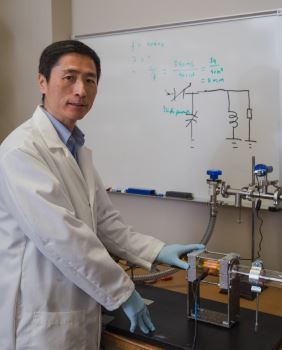
Image caption — Associate professor Qi Hua Fan is developing new electro-optical materials using this plasma processing equipment.