A team from the University of Warwick, UK, discovered that the amount of oxide that forms at the surface of automotive high-strength steels depends on the ratio between manganese and additional alloying elements. High-strength steels are obviously an important backbone for applications in the automotive industry, but cost-efficient manufacture requires the suppression of oxides within the steel during sheet production.
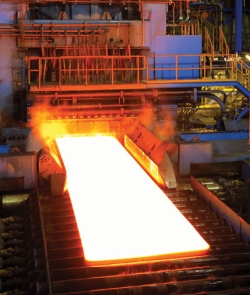
When steel sheet is produced in rolling mills at high temperatures, the surface oxidizes quickly, but the grain boundary oxides underneath define the depth of the corroded zone and also the forming limit. Hence, oxidation plays an essential role during the manufacture of high strength steels for automotive applications, because they often contain a higher amount of manganese. Due to their unique mechanical properties, this allows for a significant reduction of sheet thickness, allowing vehicles to be lighter in weight with lower carbon emissions.
The research was led by the Warwick Manufacturing Group (WMG) at the University of Warwick. The research, led by Dr. Michael Auinger of WMG, together with the Vienna University of Technology (Austria) and Voestalpine Stahl GmbH (Austria) developed a better understanding for the oxidation behavior inside steels during hot rolling, which could potentially help manufacturers to reduce the amount of steel lost during production. Therefore, adapted process parameters and knowledge about the admissible limits of alloy content would help to prevent negative effects of grain boundary oxidation during further steel processing and in-service properties of HSS car body parts.
Dr. Auinger and his co-researchers analyzed the oxidation behavior of different iron-based alloys. They found that particularly the combinations of iron-manganese and a second alloy addition – representing a simplified version of many high strength steels – undergo severe oxide formation along grain boundaries if not processed appropriately.
“Isotope exchange experiments verified that grain boundaries in manganese-containing steels are extremely susceptible to oxide formation. On the other hand, oxide particles inside the grains strongly bind their oxygen atoms. It means that new oxygen has to penetrate the entire oxide zone before forming a new oxide particle at the front,” Dr. Auinger says. “The reduced depth of internal oxidation is suggested to be caused by lowering the oxygen diffusion due to trapping reactions at crystal imperfections.”
Dr. Auinger argues that from a scientific point of view, this work is particularly important, since it indicates not that the oxidation along grain boundaries is enhanced, but that the oxidation of the alloy additions inside the metallic grains is significantly slower than predicted by theoretical simulations. This helps the understanding of the mechanisms of oxide formation. It also may enable inventing novel strategies that could help to prevent unwanted oxidation, which is currently determined by the cooling efficiency after hot rolling.