Researchers at Georgia Tech are working with Delta Air Lines Inc., both in Atlanta, on procedures for repairing composite parts used in aircraft. When Delta announced plans to purchase scores of new airplanes from Airbus and Bombardier, the carrier made clear its focus was on remaking its fleet with lighter, more fuel-efficient aircraft.
Aerospace manufacturers have relied heavily on composite materials for this latest generation of passenger jets. While composite parts have been used for decades, today as much as half of all airplane components can be made of composites, including major structures such as wings and the fuselage.
For airlines, the shift to composites creates an opportunity to rethink the repair and maintenance operations needed to keep jets in top form. Although the first of Delta’s new jets won’t enter service until fall 2017, the airline is already searching for better ways to maintain and repair composite aircraft parts—which are very different from the metal parts it has been maintaining for years
The airline is partnering with Georgia Tech to take a close look at current methods used to repair composite parts and identify ways to increase efficiency and bring down costs.
“Airlines want to create their own know-how on how to fix these structures because it’s cheaper and probably faster,” says Chuck Zhang, a professor in the Stewart School of Industrial and Systems Engineering. “But improved technologies are needed to help in the repair of composite parts. Much of it today is done by hand.”
Recently, inside Delta’s maintenance shop for composite parts, airplane nose cones stood in different stages of the process, with black markings identifying areas that needed further inspection or repair. Nearby, thrust reversers awaited sanding, finishing, and painting.
“We’ve certainly been doing composite repairs for many years,” says Todd Herrington, general manager of fleet projects at Delta. “However, what’s changed is that the type of structure now includes what we call principal structural elements—essentially the type of structure that is critical to the aircraft’s continued safe flight.”
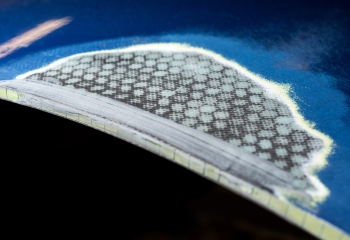
Currently, when repairs are needed for composite components that are part of an aircraft’s principal structure, technicians can use metallic or pre-cured composite patches and secure them with metal fasteners. But that’s not ideal, Herrington says.
“The more weight we permanently add to an airplane the less range or more fuel burn we’re adding to that airplane,” he says. “External repair patches are also going to add drag, which will impact aerodynamics in certain places.”
Zhang’s team is researching ways to perfect bonded repairs so that metal fasteners can be replaced with adhesives, which would preserve the composite’s lightweight advantage. And the aerospace industry isn’t the only sector that could benefit from this effort. The automotive industry, for example, also uses advanced composite materials that need improved repair technology, Zhang says.
In an effort sponsored by the National Institute of Standards and Technology, Georgia Tech has led the Consortium for Accelerated Innovation and Insertion of Advanced Composites in creating a roadmap to chart the development of composite repair technologies over the next 15 years.