Recently, a process called active screen plasma (ASP) has been developed for the purpose of minimizing or avoiding some of the limitations of conventional plasma nitriding. One such limitation is the edge effect, in which the regions near the edges of the pieces may not be nitrided to the same standard as the rest of the part.
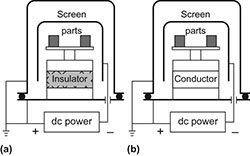
In the conventional glow-discharge process, the plasma is produced by the voltage between the wall of the chamber (positive potential) and the workpieces (negative potential). By contrast, in the ASP process, the plasma is produced by the voltage between the chamber (positive) and a screen (negative) placed around the parts. The nitriding species produced on the screen are then transferred and deposited on the part, which is then heated to the treatment temperature by radiation from the active screen, which itself is under ion bombardment.
The schematic shows active-screen plasma nitriding equipmernt. (a) Floating potential (b) Anodic potential.
Volume 4D, Heat Treating of Irons and Steels ⇒ Nitriding of Stainless Steels ⇒ Thermochemical Nitriding Treatments