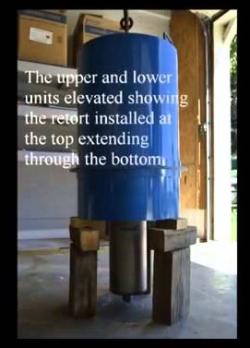
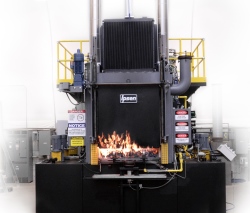
The Heavy Carbon C., Pittsford, Mich., announces that its president, George Barbour, has been awarded a patent for “A method of carburizing which allows a carburizing process in a furnace at high temperatures in a protective atmosphere.” Called Endocarb, the primary function of this method is soot control, with an atmosphere flow providing constant low methane (CH4 ) to produce a strong reaction for a high quality atmosphere regardless of carbon-potential set point
This method is said to carburize at a carbon potential well into the soot range, while maintaining a controllable carbon potential with stable CH4. This stability maintains a constant reaction, cracking an air/gas mix in a self-heated retort to a temperature of 1825°F before entry into the furnace. The high carbon potential penetrates the steel surface at a rate up to 30% faster, saving time and money while producing higher quality parts. The system can be added to existing furnaces or built into a furnace at the time of manufacture.
In addition to the speed at a higher carbon potential at high temperatures, the atmosphere will also penetrate lower-grade steels at lower temperatures without using ammonia to raise the hardness (HRC). The air/gas mix is cracked in a retort outside the furnace to form the atmosphere, and is heated at the same high temperature of 1825°F before entry into the furnace. In this manner, the low furnace temperature does not hinder the reaction that must take place in the furnace.
Soot control takes place simultaneously while the carburizing cycle is in operation; therefore, no time is lost to clean soot from the furnace, instead of taking furnace time to remove soot and clean the furnace, loads can be run instead. Time is money and soot burnout takes time. Because less time is required per load, less gas and power is wasted, resulting in more cost savings.