The microstructural feature responsible for the favorable technological properties resulting from low-temperature gaseous thermochemical treatment is a supersaturation of nitrogen and/or carbon in austenite. This is called expanded austenite.
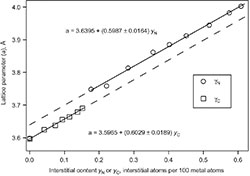
An investigation of homogenous nitrogen-expanded austenite with adjusted contents of nitrogen (as controlled by gaseous nitriding) showed that nitrogen-expanded austenite has a face-centered cubic (fcc) Bravais lattice. The study also showed that systematic hkl-dependent peak shifts with respect to the perfect fcc peak positions can be explained from the presence of stacking faults .
This is the ultimate proof that the designation “S-phase” is inappropriate, because no new phase develops, but rather a diffusion zone where the austenite lattice is expanded as a consequence of an interstitial supersaturated solid solution.
The graph shows the lattice parameter of (expanded) austenite as a function of the interstitial content of nitrogen and carbon. The data were obtained with x-ray diffraction on nitrided or carburized thin foils.
Volume 4D, Heat Treating of Irons and Steels ⇒ Heat Treated High-Alloy Steels ⇒ Low-Temperature Surface Hardening of Stainless Steel