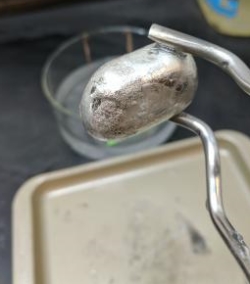
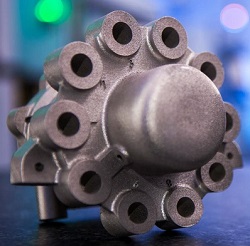
The University of Colorado at Boulder announces that its researchers have developed a technology to extract magnesium from ore in a continuous process that requires less energy and generates less waste. University researchers have launched a spinoff company called Big Blue Technologies, where they are working to translate the laboratory innovations into a viable commercial-scale enterprise.
“I’m doing it in the lab; I’m seeing the product and seeing the results,” says Boris Chubukov, a graduate researcher in CU Boulder’s Department of Chemical and Biological Engineering, and one of Big Blue Technologies’ co-founders. “I know the potential is really there.”
The U.S. Advanced Research Projects Agency provided the $3.6 million grant that funded the preliminary research. The following description of the process is from the abstract submitted to win the grant: “Continuous Production and Collection of Magnesium via Carbothermal Reduction.”
Production of magnesium based on carbothermic chemistry can be realized at temperatures below 2282°F using a combination of three operational parameters:
1) reduced pressure atmosphere,
2) addition of a catalytic material,
3) extensive size reduction of the reactant materials.
In conjunction with a continuous condensation and collection system, magnesium produced from this process entails at least a 50% reduction in energy consumption and greenhouse gas emissions compared to the predominant Pidgeon process.
The project will employ a variety of high-temperature experimental systems and methods to investigate performance of pelletized reactant materials and obtain recovered metal yields above 85%.
An optimized composition will be statistically determined and used in a low-temperature prototype reactor system for continuous production of crude magnesium.
The goal of the project is to produce a cast magnesium product and prove the reduction of energy intensity and economic feasibility with a techno-economic analysis.
The Big Blue Technologies founders believe this new process could reduce costs enough to enable production in the United States. They have secured almost a half-million dollars so far from backers who agree, including a $225,000 seed grant from the National Science Foundation’s Small Business Technology Transfer program. Early this year, the fledgling company formed a partnership with Nevada Clean Magnesium, a publicly traded company, to further develop, test, and improve the production method.
http://www.colorado.edu/today/2017/08/04/thoroughly-modern-magnesium-process