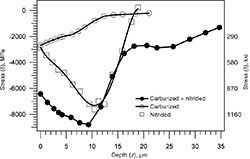
For nitrocarburizing or consecutive carburizing and nitriding, the typical stress profile is smoother than for nitriding only. The graph shows residual stress profiles determined with destructive X-ray diffraction methods in carburized/nitrided AISI 316. Carburizing/nitriding: 2 hours at 970°F in an atmosphere consisting of 30% CO-70% hydrogen, followed by nitriding (23 hours at 820°F, at KN = 1.14.
For comparison a profile for a carburized (2.5 hours at 970°F, in 90% CO/10% H2) sample and for a nitrided (22 hours at 830°F, in 100% ammonia) sample are given. Residual stress values were calculated assuming that the same elastic constants apply for expanded austenite and austenite. The presented values are therefore only an indication that very high compressive stresses are present.
Volume 4D, Heat Treating of Irons and Steels ⇒ Heat Treated High-Alloy Steels ⇒ Low-Temperature Surface Hardening of Stainless Steel ⇒ Gaseous Low-Temperature Surface Hardening of Austenitic Stainless Steel