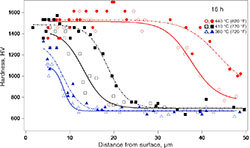
X-ray diffraction analysis indicates that the hardened case consists of a mixture of expanded austenite and expanded martensite. Dissolving nitrogen into cubic martensite causes a tetragonal expansion leading to nitrogen-expanded martensite. In addition, E-carbonitride is present close to the surface. By comparing the hardness profiles in the graph, it can be concluded that nitrocarburizing generally leads to a thicker case than nitriding, and that a slightly higher maximum hardness is obtained after nitrocarburizing.
Martensitic stainless steels have been successfully nitrided and nitrocarburized. An example is given for molybdenum-stabilized AISI 420-type austenitic stainless steel 7C27Mo2.
The graph shows hardness-depth profiles after nitriding (solid lines) and nitrocarburizing (dash-dot lines) for 16 hours of 100 μm strip 7C27Mo2 (molybdenum-modified AISI 420) at the temperatures indicated. Hardness profiles were fitted assuming a sigmoidal function.
Volume 4D, Heat Treating of Irons and Steels ⇒ Heat Treated High-Alloy Steels ⇒ Low-Temperature Surface Hardening of Stainless Steel ⇒ Low-Temperature Nitriding and Nitrocarburizing of Other Stainless Steels