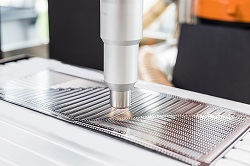
ANV Laser, Israel, introduces its noncontact Af tester (NCAT), a novel bent and free-recovery device that can determine the temperatures of Start and Finish Af (martensite-to-austenite transformation) for each of several NiTi devices of different shapes at the same time.
The NiTi test specimen is first cooled to its nominally fully martensitic phase, then is deformed by bending, and finally is heated to its fully austenitic phase while the motion (recovery) of the specimen is measured and plotted against the temperature.
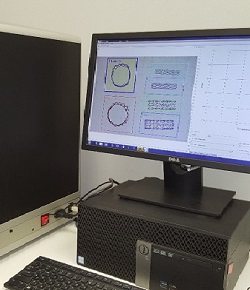
The NCAT’s proprietary image processing software automatically detects the boundary of each of the fully annealed or heat-treated nickel titanium items placed in the chilled test tray. In the user-friendly graphic interface, the tester easily deletes any non-item artifacts that were detected, and then chooses – per object — the area detection method for the test, such as inscribed or described circle, parallel lines, object boundary, and so on.
The tester then defines, for each object, the minimum and maximum boundaries for Area (to be plotted on the Y axis) and Temp (to be plotted on the X axis). The tester can also determine the rate of heating that will be generated by the NCAT’s unique heating mechanism. When satisfied with all parameters, the tester initiates the test and an Area/Temp graph is plotted for each object.
When the temperature reaches the user-defined end-temperature, the test stops automatically. The test plot for each item can be saved as a report that shows its Area/Temp graph and the calculated StartAF and Finish AF temperatures.
NCAT Benefits:
- — Volume testing, suitable for production: For the first time multiple, different-shaped parts can be tested simultaneously in the same tray.
- –Testing of very small parts: For the first time BFR testing can be carried out on parts that weigh less than 3 grams.
- — More cost-effective and more accurate than traditional BFR testing.
- — Flexibility: All test parameters can be adjusted per item, and parameter settings saved in a recipe that is easily retrieved the next time the same item is tested.
- — Customizable: The NCAT can be customized to fit a customer’s unique QA requirements.
NCAT features full control over experiment, camera, and image processing parameters: number of frames/buffer, contrast/brightness, and end temperature. It provides a wide range of object area detection methods: boundary, parallel lines, inscribed/described circle, etc. Plot boundaries (min/max AREA, min/max TEMP) can be adjusted separately for each object. NCAT enables full control over rate of heating, and the test stops automatically when it reaches the user-defined end-temperature.