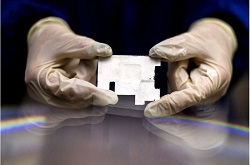
Researchers from United States Steel, Pittsburgh, studied how hydroformed advanced high strength steel responds to residual stress introduced during manufacturing at Oak Ridge National Laboratory.
“Because this is a new material containing retained austenite, we need to have a better understanding of its performance,” says Lu Huang, USS industrial research engineer. “A better understanding of how this material responds to different manufacturing processes such as stamping or hydroforming will help us validate engineering models. That will in turn make it easier to design and produce auto components that are lighter, stronger, and more durable.”
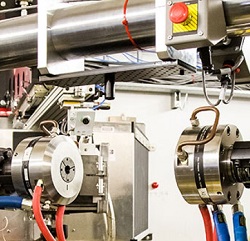
The Vulcan is a time of light diffractometer that uses neutrons from the ORNL spallation neutron source instrument (SNS). Dr. Huang decided the Vulcan was the best tool for this research because of its ability to spatially resolve the residual stress in components. Vulcan’s sample environment can also accommodate large automotive components under observation in realistic operating conditions.
Neutron diffraction provides nondestructive measurements of residual stress within the part formed with AHSS, making it possible to observe the intrinsic properties of the hydroformed parts and examine their emergence across various cross sections and lattices in great detail. This fundamental knowledge of the steel’s characteristics also laid the groundwork to probe the impact of residual stress in hydroformed steel parts on vehicle durability.
The researchers combined neutron data on residual stress distribution with computer simulations to see if they could improve the models that engineers use for designing and manufacturing auto parts.
The research team recently published its results in an SAE International technical paper (https://www.sae.org/publications/technical-papers/content/2018-01-0803/) .
Read more at: https://phys.org/news/2018-07-neutrons-advanced-high-strength-steels-vehicle.html#jCp