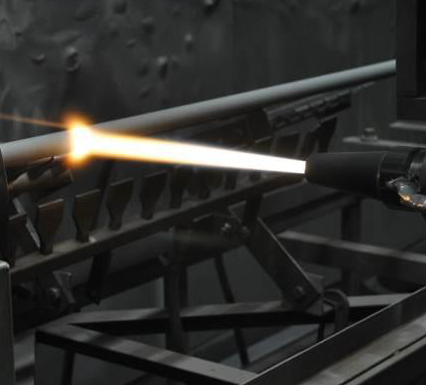
Swinburne University of Technology, Australia, announces that its researchers, in collaboration with many other scientists, have developed a new corrosion-resistant flame-spray coating that has reduced the build-up of algae and barnacles on ship hydraulic components by half. The coating consists of a single layer of carbide-based material that is applied by supersonic combustion flame spray.
Swinburne University researchers are collaborating with experts from the Defence Materials Technology Centre, MacTaggart Scott Australia, United Surface Technologies, and the Defence Science and Technology Group to advance the new technology. The scientists and industry experts came together to tackle the issue of corrosion and biofouling, which combine to impose a massive expense on the shipping industry worldwide.
“We have developed new materials and used a supersonic combustion flame jet to coat hydraulic machinery parts, and found these new protective coatings reduce biofouling by roughly 50 per cent compared to current standard coatings,” says Dr. Andrew Ang of Swinburne, one of the lead scientists on the team.
The team tested the protective coating on more than 100 samples, immersing them in seawater at three field sites around Australia from 2015 to 2017. The treatment is likely to be too expensive to be used on entire ship hulls, but it could make a big difference for critically important machinery that helps provide propulsion or heavy lifting capabilities.