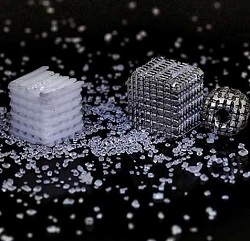
ETH Zurich researchers announce that they have succeeded in producing magnesium scaffolds with structured porosity that are suitable for bioresorbable bone implants, with the help of a 3D printed salt template.
For the treatment of complex bone fractures or even missing bone parts, surgeons typically deploy metal implants. In this context, an attractive alternative to the traditional materials such as bioinert titanium are biodegradable magnesium and its alloys. Implants made of this light metal are advantageous because they can biodegrade in the body, which can absorb magnesium as a mineral nutrient, rendering a second surgery forimplant removal unnecessary.
To promote rapid healing, the design of implants or their surfaces should be directed towards promotion of cellular adhesion or even in-growth. Materials researchers from the Laboratory of Metal Physics and Technology and the Complex Materials Group at ETH Zurich have therefore collaborated to develop a new procedure for the manufacture of magnesium implants that contain numerous structurally ordered pores, but still retain their mechanical stability. This development is the subject of a forthcoming article in Advanced Materials.
To create a porous structure, the researchers first printed a three-dimensional salt template. Because pure, standard table salt is not suitable for printing, they developed a gel-like salt paste for this purpose. The strut diameters and spacings of the salt template can be tailored by the printing process. To gain sufficient mechanical strength, the salt structure was subsequently sintered. During sintering, the fine-grained materials are heated significantly, while the temperature is chosen safely below the paste’s melting point.
The next step was to infiltrate the pores with magnesium melt. “The infiltrates obtained in this way are mechanically very stable and can be easily polished, turned and shaped,” says Jörg Löffler, Professor of Metal Physics and Technology in the Department of Materials. After mechanical shaping the researchers dissolved the salt, leaving a pure magnesium implant with numerous, regularly structured pores.
“The possibility to control the pore size, distribution and orientation in the material is decisive for clinical success, because bone cells like to grow into these pores,” says Prof. Löffler. Growth into pores is in turn decisive for the rapid integration of the implant in bone.