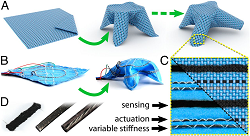
Yale University, Conn., researchers have developed robotic fabrics by integrating functional fibers into conventional textiles. Fabrics, with their interlocking fibers, tend to be breathable, lightweight, and highly compact materials. Rebecca Kramer-Bottiglio and colleagues explored the design of independently functioning fabric machines and developed a standalone platform for robotic fabrics.
Flattened heat-responsive Nitinol shape-memory alloys were used as the actuator. Field’s metal, an alloy that liquifies at relatively low temperatures, along with epoxy composite variable support fibers were incorporated to lend stiffness to the fabric when needed, such as when supporting a load. Finally, the fibers were painted with conductive ink that can sense the strain or bending of the fabric to help control and hold curvatures. By incorporating these fibers into conventional fabrics, the researchers developed a robotic tourniquet and shape-changing napkin-sized robotic sheet that automatically folds into a box capable of supporting 50 g of weight.
Established textile manufacturing processes could eventually be leveraged for the production of rolls of robotic fabric that could be used to make self-reconfiguring machinery. These fabrics present a means to create smart adaptable clothing, self-deployable shelters, and lightweight shape-changing machinery.
Read further here.
Image credit:
Roboticizing fabric by integrating functional fibers. Trevor L. Buckner, R. Adam Bilodeau, Sang Yup Kim, Rebecca Kramer-Bottiglio. Proceedings of the National Academy of Sciences Oct 2020, 117 (41) 25360-25369; DOI: 10.1073/pnas.2006211117