In a new study that seeks to identify the reasons that cause the performance of fast charged lithium-ion batteries to degrade in electric vehicles, scientists at the U.S. Department of Energy’s Argonne National Laboratory, Lemont, Ill., found interesting chemical behavior in one of the battery’s two terminals as the battery is charged and discharged.
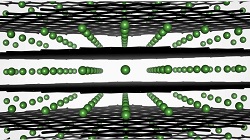
Lithium-ion batteries contain both a positively charged cathode and a negatively charged anode separated by an electrolyte that moves lithium ions between them. The anode in these batteries is typically made out of graphite, assembled out of small particles. Inside these particles, the lithium ions can insert themselves in a process called intercalation. When intercalation happens properly, the battery can successfully charge and discharge.
When a battery is charged too quickly, instead of smoothly getting into the graphite, the lithium ions tend to aggregate on top of the anode’s surface, resulting in a plating effect that can cause terminal damage.
“Plating is one of the main causes of impaired battery performance during fast charging,” said Argonne battery scientist Daniel Abraham, an author of the study, published in the Journal of the Electrochemical Society. “As we charged the battery quickly, we found that in addition to the plating on the anode surface there was a buildup of reaction products inside the electrode pores.” As a result, the anode itself undergoes some degree of irreversible expansion, impairing battery performance.
Using a technique called scanning electron nanodiffraction, Abraham and colleagues at the University of Illinois Urbana-Champaign observed another notable change to the graphite particles. At the atomic level, the lattice of graphite atoms at the particle edges becomes distorted because of the repeated fast charging, hindering the intercalation process. “Basically, what we see is that the atomic network in the graphite becomes warped, and this prevents lithium ions from finding their ‘home’ inside the particles—instead, they plate on the particles,” he said.
“The faster we charge our battery, the more atomically disordered the anode will become, which will ultimately prevent the lithium ions from being able to move back and forth,” Abraham said. “The key is to find ways to either prevent this loss of organization or to somehow modify the graphite particles so that the lithium ions can intercalate more efficiently.”
Image – Intercalation of lithium ions (green) in a graphite anode. Courtesy of: Argonne National Laboratory
For more information:
Argonne National Laboratory