Two University of Arizona professors are developing new materials to 3D-print objects designed to withstand those high speeds. A $1.2 million grant from the Office of Naval Research’s Defense University Research Instrumentation Program will fund a suite of new equipment to support the work and contribute to the Arizona Research Center for Hypersonics.
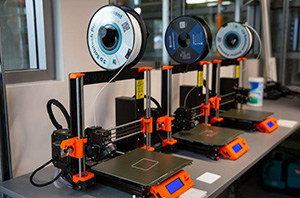
3D printing, or additive manufacturing, offers much more design flexibility than traditional manufacturing, allowing people to create precise geometries that aren’t otherwise possible. It offers a new world of possibilities for the field of hypersonic flight, such as incorporating cooling pipes directly into the structure of a vehicle.
“In forging, for example, you take a chunk of metal, you heat it up and you squish it into the shape you want,” said Andrew Wessman, UArizona assistant professor of materials science and engineering. “If you try to take that same material, you can make it into a powder and then print with it. And it prints OK, but it’s not really optimal.”
Until now, most metal additive manufacturing specialists have used metal alloys that were originally developed for traditional manufacturing processes. For instance, the alloy Inconel 718, which was developed in the 1950s specifically for forging, has a mixture of elements like nickel, chrome and iron designed to give it maximum strength. But it also has some elements that cause the material, when processed via additive manufacturing, to become brittle.
Wessman and Sammy Tin, head of the Department of Materials Science and Engineering in the College of Engineering, will create novel metallic alloys optimized to be used in the additive manufacturing process and to withstand the extreme conditions of hypersonic flight, particularly at high temperatures and stress levels.
Because of friction, objects traveling at hypersonic speeds experience temperatures of up to 5,000 degrees Fahrenheit. So, heat resistance is one of the most critical features of the alloys the team will develop. The materials will also need to be resistant to oxidation and other “wearing out” processes.
Ceramics are more heat-resistant than metal, so hypersonic vehicles are often coated with specialized ceramics that can withstand ultra-high temperatures. But the vehicles are made largely of metal, which is less brittle and better able to bear mechanical loads.
“Underneath the ceramic, there has to be metal,” Tin said. “If we can improve the temperature capabilities of those metallic structures, that offers significant design and performance benefits.”
While the team’s initial work is focused on manufacturing materials for hypersonic environments, the research can also be applied to other areas, such as manufacturing of high-performance components for jet and rocket engines.
“Hypersonic flight and space exploration are among our university’s biggest strengths, and both require materials that can withstand extreme environments,” said University of Arizona President Robert C. Robbins. “I am proud to have faculty members like Sammy Tin and Andrew Wessman working in this critical area and raising the University of Arizona’s already-impressive profile in advanced manufacturing.”
For more information: The University of Arizona