Cutting-edge materials science and engineering play a key role in clean energy conversion. Sustainable development sets the goal for researchers across disciplines, requiring active collaborations to optimize impacts. Dr. Xiao Zhang, Assistant Professor in the Department of Mechanical Engineering at The Hong Kong Polytechnic University (PolyU), is leading research efforts focused on advanced materials and electrochemical reactors for clean energy conversion.
Dr. Zhang’s research on sustainable energy sources and production has received significant citations, spanning multiple disciplines such as materials science, chemistry, chemical, and mechanical engineering. The research focuses on achieving decarbonization through clean electricity with special emphasis on the production of valuable chemicals from the earth’s abundant resources.
Engineering plays a crucial role in promoting sustainable development by creating solutions for energy systems, production, and resource management that can reduce carbon emissions, conserve resources and protect the environment. The primary focus of Dr. Zhang’s highly cited papers is the exploration of novel layered materials for clean energy conversion. His research interests also extend to the conversion of waste pollutants such as carbon dioxide, nitrate and biomass into valuable chemicals and fuels.
Dr. Zhang said, “I am thrilled by this prominent achievement to influence frontier sciences and subsequent innovative applications. Our research has enhanced scientific knowledge in materials science and chemical engineering, particularly in the understanding of 2D materials and development of electrochemical reactors for sustainable production.”
Advancing the knowledge of material structures and catalytic processes is crucial to clean energy production. Dr. Zhang said, “Our research has facilitated the development of practical reactors capable of producing valuable chemicals at an industrial-relevant rate. These novel findings have significant impact on the development of sustainable manufacturing, environmental remediation and resources efficiency.”
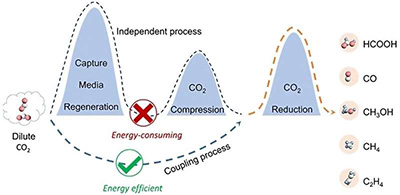
Increasingly concerns about the rising levels of carbon dioxide (CO2) and its influence on climate change have made it essential to create efficient strategies to reduce CO2 emissions. Dr. Zhang’s team identifies the potential of integrating CO2 capture and electrochemical conversion as a promising approach to tackle this challenge.
Recently, Dr. Zhang and his research team have made a noteworthy advancement in the sustainable energy field through their groundbreaking study.
A comprehensive investigation was conducted in the study to develop an efficient and sustainable system that captures CO2 from emission sources, and subsequently converts it into valuable chemicals or fuel.
The findings provide valuable insights and practical strategies for researchers, policymakers, and industries working towards sustainable CO2 management and developing a circular carbon economy. The integration of CO2 capture and electrochemical conversion can help us move toward a greener and more sustainable future.
The transition from the ubiquitous goal of sustainability and clean energy to intricate scientific concepts and discoveries poses the challenge of consistently pushing the boundary of knowledge while upholding high research standards and adapting to evolving technological landscape. Throughout the research journey, Dr. Zhang’s studies have fostered interdisciplinary collaborations in pursuit of sustainable developments across various fields.
“Knowing that your work has significantly impacted the field, leading to further discoveries and innovations, is immensely rewarding. While keeping up with the latest advancements and addressing new research questions can be demanding, it is also highly fulfilling,” said Dr. Zhang.
Looking forward, Dr. Zhang said, “I am actively seeking collaborative opportunities while staying focused on my research vision. My goal is to drive positive change and advance the field of clean energy conversion.”
For more information: ACS Publications