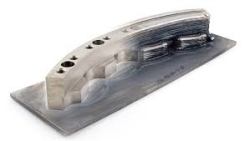
Distortion in tool steels encompasses all irreversible dimensional changes. There are two main types: size distortion and shape distortion. Size distortion involves expansion or contraction in volume or linear dimensions without changes in geometrical form. Shape distortion entails changes in curvature or angular relations, as in twisting, bending, and/or nonsymmetrical changes in dimensions. In most cases both types of distortion occur during a heat-treatment operation.
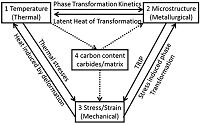
Some of the main interactions occur between temperature, microstructure, and stress/strain. Especially for tool steels these interactions are mainly influenced by the carbon content in the steel matrix, the types and relative amounts of the alloying elements, and the carbide formation/transformation/precipitation characteristics of the alloy system.
For more information, click on the link below (subscription required). Then scroll to Figure 1..
R Schneider; R. Mesquita; W Schützenhöfer, Distortion in Tool Steels, ASM International, 2014, https://doi.org/10.31399/asm.hb.v04d.a0005958