A bullet piercing the protective armor of a first responder, a jellyfish stinging a swimmer, micrometeorites striking a satellite: High-speed projectiles that puncture materials show up in many forms. Researchers constantly aim to identify new materials that can better resist these high-speed puncture events, but it has been hard to connect the microscopic details of a promising new material to its actual behavior in real-world situations.
To address this issue, researchers at the National Institute of Standards and Technology (NIST), Gaithersburg, Md., designed a method that uses a high-intensity laser to blast microscale projectiles into a small sample at velocities that approach the speed of sound. The system analyzes the energy exchange between the particle and the sample of interest at the micro level then uses scaling methods to predict the puncture resistance of the material against larger energetic projectiles, such as bullets encountered in real-world situations. This new method, described in the journal ACS Applied Materials & Interfaces, reduces the need to perform a lengthy series of lab experiments with larger projectiles and bigger samples.
During lab experiments, synthesizing small amounts of a new polymer — e.g., a few milligrams from glassware the size of a coffee cup — can be fairly routine. The challenge comes with scaling up to produce kilograms of material to be able to test its puncture resistance. For materials made from new synthetic polymers, scaling up to sufficient quantities is often not possible or practical.
“The problem with ballistic tests is that you must take two steps when making new materials. You need to synthesize a new polymer that you think will be better, and then scale it up to kilogram size. That is a big jump. The biggest accomplishment of this work is that we surprisingly show that the micro-ballistic tests can be scaled and linked to real-world large-scale tests,” said NIST materials research engineer Christopher Soles.
During the course of the study, researchers used their method to evaluate several materials, including a widely used compound for bulletproof glass, a novel nanocomposite, and the strong, all-carbon material known as graphene.
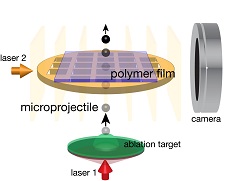
The test is called LIPIT, which stands for laser-induced projectile impact testing. It uses lasers to launch a microprojectile made of either silica or glass into a thin film of the material of interest. Through a process called laser ablation, the laser creates a high-pressure wave that propels the microprojectile material toward the sample.
The researchers first used the method to analyze a nanocomposite material known as polymer-grafted nanoparticle polymethacrylate (npPMA) composite. It consists of silica nanoparticles that could be useful in a wide range of applications including body armor. The laser propels microprojectiles at velocities from 100 to 400 meters per second at the target material and measures their impact using a video camera.
Researchers connected the results of the microprojectile test to what would happen in larger-scale impacts by combining the measurements they obtained on the npPMA with additional mathematical analysis while incorporating existing data on the material from the research literature. Since npPMA is a novel material and not easy to make, they expanded their analysis to also include a more commonly available compound known as polycarbonate, which is widely used as a bullet-resistant glass.
The combined approach of using literature results, dimensional analysis and LIPIT allowed researchers to show that the puncture resistance of a material is tied to the maximum stress a material can take before it breaks, called failure stress. This challenges the current understanding of ballistic performance, which is typically thought to be related to how pressure waves travel through the material.
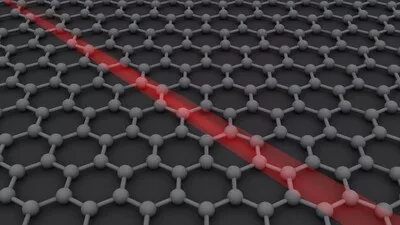
Their new approach can identify the strength limits of a material, or how much stress and pressure it can handle, without having to directly measure these properties beforehand, which can help optimize which materials to choose in experiments. This then enabled them to explore materials such as graphene, which showed that multiple film layers of the material can be used in impact resistance applications similarly to high-performance polymers.
“This new paradigm gives us a new experimental tool to evaluate the hype of some of these graphene and other 2D materials that are predicted to have excellent ballistic properties. We have the potential to experimentally verify if these materials would outperform classic ballistic resistant materials like polycarbonates, even without scaling up the synthesis of novel 2D materials, which would be prohibitively costly,” said Soles.
The researchers expect their methodology to open up many new possibilities for investigating the behavior of materials.
Image – NIST researchers designed a method that uses a high-intensity laser to blast microprojectiles at velocities close to the speed of sound at a target material, in this case a thin polymer film representing the puncture-resistant material to be tested. The test is called LIPIT, which stands for laser-induced projectile impact testing. Combining the test with analysis and scaling methods, scientists can discover new puncture-resistant materials. Courtesy of: E. Chan/NIST.
For more information:
National Institute of Standards and Technology