Motion control is necessary to ensure operator safety and coating quality. Although handheld spraying has been carried out for nearly a century, it is not the preferred or safest means of spraying. The thermal spray environment is harsh and not suited for handheld operations.
Safety has become more of an issue as HVOF and plasma energies and velocities have continued to increase. Operator fatigue (typical surface speeds are 30 m/min, or 1200 in/min) and inconsistency also affect coating uniformity. Part- and gun-handling equipment is required to eliminate the operator from the process. Commercially available, off-the-shelf motion-control equipment usually takes the form of turntables, x–y manipulators, and six-axis robots.
Where the production volume of a specific part warrants the investment, specialized tooling is often used. The disadvantage of using manipulators is in spraying small numbers of complex parts. In limited production runs, programming the manipulation equipment can be more expensive and time-consuming than spraying the part. There are many applications where handheld spraying seems to be the only practical approach to the problem, for example, bridges, boilers, architecture, artwork, one-of-a-kind parts, and so forth.
High-volume production spraying dictates that ancillary processes such as surface cleaning, masking, and grit blasting also be automated. Coating process cells, which represent the highest level of automation, may include pick-and-place robots to handle part loading and unloading.
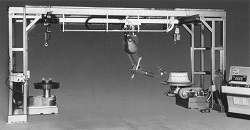
The figure shows an automated thermal spray cell for coating aircraft engine components. In this plasma spray cell, the operator loads and unloads parts, and the spray cell does all of the operations, including process control, statistical process control, quality inspection for thickness, and final processing. Although expensive, such equipment is justified for coating applications where consistency is critical.
Image – Advanced thermal spray cell. Courtesy of Sulzer Metco.
This information is from ASM Handbooks Online, Vol. 5A: Thermal Spray Technology, Coating Structures, Properties, and Materials. To find this information (subscription required), click on the link below and scroll down to Figure 11.