Harvard scientists, in collaboration with an international and interdisciplinary team of researchers, are exploring how cracks start, propagate, and end. Their findings, detailed in papers published in Nature Physics and AGU Advances, provide a deeper understanding of the lifecycle of fractures and could improve our understanding of material science, earthquakes, and production of geothermal energy, oil, and gas.
The research represents a collaboration between material scientists, geophysicists, and seismologists. Initially, the research team led by David A. Weitz, the Mallinckrodt Professor of Physics and of Applied Physics at SEAS, wanted to better understand how natural rocks fracture during hydraulic fracturing. The team included researchers from the China University of Petroleum (Beijing), University of Nottingham, Tufts University, the University of Washington, and the Hebrew University of Jerusalem.
“Fracturing is well understood in two dimensions but more realistic fractures in complex, three-dimensional materials present a plethora of complex behaviors which are widely studied yet remain poorly understood at a fundamental level,” said Weitz, senior author on both papers.
To understand fractures in three dimensions, the team introduced a crack in a transparent material, and then injected liquids of varying viscosities. Using a high-speed camera that can capture 100,000 images per second with a spatial resolution of a couple of micrometers and cutting-edge acoustic emission sensors, the team was able to visualize and listen to the dynamics of fractures as they spread through the material.
The team found that rather than moving through a material like a continuous wave, fractures move in starts and stops, propagating from their origin in a material outward through a series of high-speed jumps.
“It’s a really dynamic process,” said Cochard. “A new crack forms somewhere along the stalled front line of the fracture, locally distorting it, causing the expansion of the crack at the speed of sound in the direction of the fracture line and then the fluid follows. The crack stops, the fluid penetrates inducing a stress at the fracture front where a new crack starts over again following the same dynamics.”
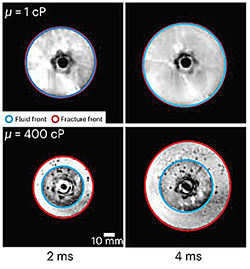
The team found that the amplitude and the time between these jumps depends on the viscosity of the liquid. With low viscosity liquids, like water, the time between jumps is miniscule as the fluid penetrates the crack almost instantaneously. With higher viscosity fluids, like glycerol, which has viscosity similar to honey, the lag between the so-called fracture front (where the crack is) and the fluid front (where the liquid tip is) increases as it takes longer for the high-viscosity fluid to penetrate the crack and expand it.
The researchers also turned their attention to earthquakes—which, after all, are caused by fractures in tectonic plates. Specifically, the team looked at slow slip and tectonic tremor, also known as slow earthquakes.
“Slow earthquakes are very interesting and important because they could potentially trigger big earthquakes, although they move slowly compared to regular earthquakes,” said Congcong Yuan, a graduate student in Earth and Planetary Sciences at Harvard and first author of the AGU Advances paper. “Previous studies have observed that fluids can play a role in regulating slow slip and tectonic tremor events but how hydrofractures regulate fluid flow and interact with shear cracks has not been understood.”
The team simulated slow earthquakes by introducing a crack in a material by injecting fluid and using slow-motion videos and acoustic emissions to map the propagation of cracks. The start/stop fracture dynamics observed in the experiments were similar to real-world observations of tectonic tremors in the Cascadia region of the United States.
Evidence of hydraulic fracturing can also be found in the geological record of rock outcrops from the depth of tectonic tremors.
“Building off previous studies, our work proposes that tectonic tremors may not solely be shear slips between two plates but could also be caused by hydraulic fractures, which promote fluid transport and overall shear slips,” said Yuan.
“Taken together, these two papers reflect the collaboration and advances spurred by two research fields—material sciences and earthquake sciences,” said Denolle.
Image – Images of a fracture 2 ms (top) and 4 ms (bottom) after crack initiation. Courtesy of Nature Physics, 2024, doi: 10.1038/s41567-023-02365-0.
************
For more information:
Harvard John A. Paulson School of Engineering