A research team led by Prof. Lu Qingyou from Hefei Institutes of Physical Science (HFIPS) of the Chinese Academy of Sciences (CAS) achieved a breakthrough by creating a unique magnetic force microscope (MFM) that can image air-sensitive materials without requiring surface protection coatings. The successful development of this glovebox-assisted MFM system marks a significant advancement in scientific instrumentation.
The study of magnetic characteristics in two-dimensional van der Waals materials holds immense promise for applications in spintronics and high-density data storage due to their nanoscale and atomic-scale magnetic structures. However, air sensitivity makes it difficult to characterize the intrinsic magnetic properties of these materials directly.
In this research, the compact MFM system addresses this challenge by providing a controlled environment for imaging air-sensitive materials with precision and reliability.
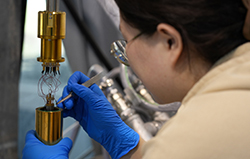
“It’s small,” said Dr. Zhang Yuchen, a member of the team, “and as the microscope can be taken apart, we are able to conduct the whole process in an inert gas with the help of a glovebox.”
What she is referring to is a unique detachable sealed chamber of the MFM probe. When moving sensitive samples from a glovebox to a low-temperature, high-magnetic-field environment, it can effectively protect them from air exposure.
This ensures the integrity and cleanliness of the sample surface, allowing for the capture of high-resolution images that reveal the intrinsic magnetic structures of materials such as chromium triiodide (CrI3).
This invention marks a significant step forward in magnetic microscopy technology. “It paves the way for future advancement in magnetic materials research and next-generation magnetic storage devices,” said Dr. Zhang.
The team’s work was published in Review of Scientific Instruments.
Image – Glovebox-assisted magnetic force microscope offers easier image analysis of air-sensitive samples. Courtesy of Zhao Weiwei.
************
For more information:
Hefei Institutes of Physical Science, Chinese Academy of Sciences