Researchers from Microsoft, Redmond, Wash., and Pacific Northwest National Laboratory, (PNNL), Richland, Wash., discovered a new battery material by combining two computing superpowers: artificial intelligence and supercomputing.
Calculations winnowed down more than 32 million candidate materials to just 23 promising options in just 80 hours. The team synthesized and tested one of those materials and created a working battery prototype, reporting their results in a paper submitted to arXiv.org.
The researchers targeted a coveted type of battery material: a solid electrolyte. An electrolyte is a material that transfers ions — electrically charged atoms — back and forth between a battery’s electrodes. In standard lithium-ion batteries, the electrolyte is a liquid. But that comes with hazards, like batteries leaking or causing fires. Developing batteries with solid electrolytes is a major aim of materials scientists.
The original 32 million candidates were generated via a game of mix-and-match, substituting different elements in crystal structures of known materials. Sorting through a list this large with traditional physics calculations would have taken decades, says computational chemist Nathan Baker of Microsoft. But with machine learning techniques, which can make quick predictions based on patterns learned from known materials, the calculation produced results in just 80 hours.
First, the researchers used AI to filter the materials based on stability, namely, whether they could actually exist in the real world. That pared the list down to fewer than 600,000 candidates.
Further AI analysis selected candidates likely to have the electrical and chemical properties necessary for batteries. Because AI models are approximate, the researchers filtered this smaller list using tried-and-tested, computationally intensive methods based on physics. They also weeded out rare, toxic, or expensive materials.
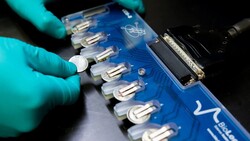
That left the researchers with 23 candidates, five of which were already known. Researchers at PNNL picked a material that looked promising — it was related to other materials that the researchers knew how to make in the lab, and it had suitable stability and conductivity. Then they set to work synthesizing it, eventually fashioning it into a prototype battery. And it worked.
“That’s when we got very excited,” says materials scientist Vijay Murugesan of PNNL. Going from the synthesis stage to the functional battery took about six months. “That is superfast.”
The new electrolyte is similar to a known material containing lithium, yttrium, and chlorine, but swaps some lithium for sodium — an advantage as lithium is costly and in high demand.
Combining lithium and sodium is unconventional. “In a usual approach … we would not mix these two together,” says materials scientist Yan Zeng of Florida State University in Tallahassee, who was not involved in the research. The typical practice is to use either lithium or sodium ions as a conductor, not both. The two types of ions might be expected to compete with one another, resulting in worse performance. The unorthodox material highlights one hope for AI in research, Zeng says: “AI can sort of step out of the box.”
In the new work, the researchers created a series of AI models that could predict different properties of a material, based on training data from known materials. The AI architecture is a type known as a graph neural network, in which a system is represented as a graph, a mathematical structure composed of “edges” and “nodes.” This type of model is particularly suited for describing materials, as the nodes can represent atoms, and the edges can represent bonds between the elements.
To perform both the AI and physics-based calculations, the team used Microsoft’s Azure Quantum Elements, which provides access to a cloud-based supercomputer tailored for chemistry and materials science research.
The project is an example of a practice in which a company uses its own product to confirm that it works. Hopefully, in the future, others will pick up the tool and use it for a variety of scientific endeavors.
Image – A new type of battery, based on a material discovered with the help of AI, is shown being tested in the laboratory. Courtesy of: Dan DeLong/Microsoft.
For more information:
Microsoft Corporation
https://www.microsoft.com/en-us
Pacific Northwest National Laboratory
https://www.pnnl.gov/