Oerlikon, a leading global provider of surface and additive manufacturing solutions and services, announces the establishment of an Advanced Coating Technology Center in Westbury, N.Y., dedicated to advancing technologies for the aerospace and gas turbine industries.
Continue readingElevATE Semiconductor and GlobalFoundries partner on high-voltage chips for commercial and national security applications
ElevATE Semiconductor, San Diego, Calif., and GlobalFoundries (GF) announced a manufacturing partnership for high-voltage chips produced at GF’s facility in Essex Junction, Vermont.
Continue reading“Nanostitches” enable lighter and tougher composite materials
Interest has been growing in the development of nanostructured hybrid composite materials, where nanoparticles such as carbon nanotubes (CNTs) are used alongside microscale-fiber composite laminates.
Composite materials have one main vulnerability: the space between layers, which is typically filled with polymer “glue” to bond the layers together. In the event of an impact or strike, cracks can easily spread between layers and weaken the material, even though there may be no visible damage to the layers themselves. Over time, as these hidden cracks spread between layers, the composite could suddenly crumble without warning.
Now, MIT engineers have shown they can prevent cracks from spreading between composite’s layers, using an approach they developed called “nanostitching,” in which they deposit chemically grown microscopic forests of carbon nanotubes between composite layers. The tiny, densely packed fibers grip and hold the layers together, like ultrastrong Velcro, preventing the layers from peeling or shearing apart.
In experiments with an advanced composite known as thin-ply carbon fiber laminate, the team demonstrated that layers bonded with nanostitching improved the material’s resistance to cracks by up to 60 percent, compared with composites with conventional polymers. The researchers say the results help to address the main vulnerability in advanced composites.
“Just like phyllo dough flakes apart, composite layers can peel apart because this interlaminar region is the Achilles’ heel of composites,” says Brian Wardle, professor of aeronautics and astronautics at MIT. “We’re showing that nanostitching makes this normally weak region so strong and tough that a crack will not grow there. So, we could expect the next generation of aircraft to have composites held together with this nano-Velcro, to make aircraft safer and have greater longevity.”
At MIT, Wardle is director of the necstlab (pronounced “next lab”), where he and his group first developed the concept for nanostitching. The approach involves “growing” a forest of vertically aligned carbon nanotubes — hollow fibers of carbon, each so small that tens of billions of the the nanotubes can stand in an area smaller than a fingernail. To grow the nanotubes, the team used a process of chemical vapor deposition to react various catalysts in an oven, causing carbon to settle onto a surface as tiny, hair-like supports. The supports are eventually removed, leaving behind a densely packed forest of microscopic, vertical rolls of carbon.
The lab has previously shown that the nanotube forests can be grown and adhered to layers of composite material, and that this fiber-reinforced compound improves the material’s overall strength. The researchers had also seen some signs that the fibers can improve a composite’s resistance to cracks between layers.
In their new study, the engineers took a more in-depth look at the between-layer region in composites to test and quantify how nanostitching would improve the region’s resistance to cracks. In particular, the study focused on an advanced composite material known as thin-ply carbon fiber laminates.
The study’s experiments were led by Carolina Furtado, who joined the effort as part of the MIT-Portugal program in 2016, continued the project as a postdoc, and is now a professor at the University of Porto in Portugal, where her research focuses on modeling cracks and damage in advanced composites.
In her tests, Furtado used the group’s techniques of chemical vapor deposition to grow densely packed forests of vertically aligned carbon nanotubes. She also fabricated samples of thin-ply carbon fiber laminates. The resulting advanced composite was about 3 millimeters thick and comprised 60 layers, each made from stiff, horizontal fibers embedded in a polymer sheet.
She transferred and adhered the nanotube forest in between the two middle layers of the composite, then cooked the material in an autoclave to cure. To test crack resistance, the researchers placed a crack on the edge of the composite, right at the start of the region between the two middle layers.
“In fracture testing, we always start with a crack because we want to test whether and how far the crack will spread,” Furtado explains.
The researchers then placed samples of the nanotube-reinforced composite in an experimental setup to test their resilience to “delamination,” or the potential for layers to separate.
“There’s lots of ways you can get precursors to delamination, such as from impacts, like tool drop, bird strike, runway kickup in aircraft, and there could be almost no visible damage, but internally it has a delamination,” Wardle says. “Just like a human, if you’ve got a hairline fracture in a bone, it’s not good. Just because you can’t see it doesn’t mean it’s not impacting you. And damage in composites is hard to inspect.”
To examine nanostitching’s potential to prevent delamination, the team placed their samples in a setup to test three delamination modes, in which a crack could spread through the between-layer region and peel the layers apart or cause them to slide against each other, or do a combination of both. All three of these modes are the most common ways in which conventional composites can internally flake and crumble.
The tests, in which the researchers precisely measured the force required to peel or shear the composite’s layers, revealed that the nanostitched held fast, and the initial crack that the researchers made was unable to spread further between the layers. The nanostitched samples were up to 62 percent tougher and more resistant to cracks, compared with the same advanced composite material that was held together with conventional polymers.
“This is a new composite technology, turbocharged by our nanotubes,” Wardle says.
For more information: ACS Applied Materials and Interfaces

Searching space for stealthy dark matter
From deep underground to outer space, researchers supported by the DOE’s Office of Science are working to understand this mysterious type of matter.
Continue readingNorthrop Grumman acquires Orbital ATK for its aerospace and defense technologies
Orbital ATK Inc., Dulles, Va., announces that its stockholders have overwhelmingly approved a merger agreement providing for the acquisition of Orbital ATK by Northrop Grumman Corp.
Continue readingNorthrop Grumman to acquire Orbital ATK to expand capabilities and accelerate innovation
Northrop Grumman Corp., Falls Church, Va., a leading global security company; and Orbital ATK Inc., Dulles, Va., a global leader in aerospace and defense technologies, announce that they have entered into a definitive agreement under which Northrop Grumman will acquire Orbital ATK for approximately $7.8 billion in cash, plus the assumption of $1.4 billion in net debt.
Continue readingEU and Japan team up to develop new advanced materials
The EU and Japan are strengthening their research relationship with the launch of an enhanced dialogue on advanced materials.
Under this agreement, the EU and Japan will work on developing new materials that are used in critical sectors of the economy, such as renewable energy, batteries, zero-emission buildings and semiconductors. It aims to create a platform for sharing information on policy developments and exploring collaborative research opportunities.
The EU said these materials are also important for both the green and digital transitions and are a “vital part of economic sovereignty and strategic independence”.
The EU describes advanced materials as those that are engineered to display superior performance or special functions. A key example is graphene, a one-atom-thick layer of carbon that has many potential applications due to its flexibility and conductivity.
The EU expects the demand for advanced materials to increase significantly in the coming years and believes itself – and Japan – have a global lead in this technology. The agreement follows a recent strategy proposed by the European Commission to move towards “EU industrial leadership” in advanced materials.
The new agreement builds on the success of the EU’s collaboration with Japan in material sciences, which included the development of new materials for the substitution of critical metals and advanced materials for power electronics. EU commissioner Iliana Ivanova said the new dialogue on advanced materials “strengthens our cooperation with Japan in research and innovation”.
“These materials are critical for our transition to a green future, and by joining forces, we can get there faster,” Ivanova said. “I look forward to seeing the results of this new cooperation with Japan.”
For more information: European Commission
Lincotek acquires Hitemco, an industry leader in thermal spray and diffusion coatings
Global contract manufacturer Lincotek, Italy, acquired Hitemco, Old Bethpage, N.Y., emphasizing the strong interest of Lincotek on the U.S. market.
Continue readingASM Fellow Paul Bania receives Lifetime Achievement Award from the International Titanium Association
ASM Fellow Dr. Paul J. Bania, titanium metallurgist, researcher, and inventor, will receive the Lifetime Achievement Award from the International Titanium Association during the organization’s 30th annual conference in Chicago, September 21-24, 2014.
Continue readingAircelle to produce titanium exhaust systems for Boeing 777X
Aircelle (Safran), Le Havre, France, will produce titanium exhaust systems for the new Boeing 777X commercial jetliner, marking the nacelle manufacturer’s first major supplier win with Boeing.
Continue readingConstellium Ravenswood selected by US Department of Energy to receive $75 million investment to deploy low to zero carbon technology
Constellium, France, announced that its facility located in Ravenswood, W. Va., was selected by the U.S. Department of Energy Office of Clean Energy Demonstrations to begin award negotiations for up to $75 million in Bipartisan Infrastructure Law and Inflation Reduction Act funding as part of the Industrial Demonstrations Program.
Continue readingSynopsys to acquire Ansys, creating a leader in silicon to systems design solutions
Synopsys, Sunnyvale, Calif., and Ansys, Canonsburg¸Pa., announced that they have entered into a definitive agreement under which Synopsys will acquire Ansys.
Continue readingSurface Navy 2024: US Navy looks to accelerate cold spray applications
The US Navy is seeking to expand its use of cold spray technology to repair and maintain its platforms and improve fleet readiness.
Continue readingFlame Spray North America expands operations in Laurens County, S.C.
Flame Spray North America, Italy, a thermal spray coatings manufacturer, announced it is expanding its operations in Laurens County, South Carolina, creating 40 new jobs.
Continue readingPortable mass spectrometer components made via 3D printing
Using additive manufacturing, researchers at the Massachusetts Institute of Technology (MIT) in Cambridge, Mass., produced a mass filter, which is the core component of a mass spectrometer, that is far lighter and cheaper than the same type of filter made with traditional techniques and materials.
Continue readingNASA’s Bennu asteroid sample contains carbon and water
Initial studies of the 4.5-billion-year-old asteroid Bennu sample collected in space and brought to Earth by NASA show evidence of high-carbon content and water, which together could indicate the building blocks of life on Earth may be found in the rock.
Continue readingTesting the limits of an ancient artform to increase aircraft range
As part of a prestigious 2023 summer internship with the U.S. Department of Defense, John Migliore, a fourth-year Ph.D. candidate at The University of North Carolina at Chapel Hill departments of applied physical sciences and chemistry, conducted tests on whether high-performance polymers would change the mechanical and structural properties of ceramic materials.
Continue readingSpirit Electronics to provide device analysis with acquisition of Insight Analytical Labs
Spirit Electronics, Phoenix, AZ, acquired Insight Analytical Labs, Colorado Springs, CO, to add device analysis services including destructive physical analysis, to its existing full-turnkey semiconductor supply chain services.
Continue readingCurtiss-Wright’s Keronite business secures Nadcap approval certification
Curtiss-Wright Surface Technologies Division, Paramus, N.J., announced its Keronite business, a world leader in plasma electrolytic oxidation applications including a pioneering surface treatment that uniquely enhances the performance of light alloys, has successfully secured Nadcap accreditation for Chemical Processing at its Greenwood, Ind. facility.
Continue readingEngineering solutions through advanced materials
The U.S. Army Engineer Research and Development Center (ERDC) is conducting innovative research on advanced materials and manufacturing technologies that will play a vital role in both civilian and military applications.
Continue readingNorth Star Imaging unveils 9 MeV high energy x-ray system in Florida
North Star Imaging, Rogers, MN, recently opened an x-ray inspection services laboratory in Orlando, Florida. The facility houses a vault with a 9 Million Electron Volt high energy CT X-ray system capable of scanning very large dense parts used in aerospace and aviation.
Continue readingTitomic enters next step of commercialization with Boeing
Titomic Limited, Australia, has received a purchase order from Boeing Space, Intelligence, and Weapons Systems for AUD 132,174 to continue flight qualifications of Titomic Kinetic Fusion manufactured components initiated in 2021.
Continue readingAerobraze OKC awarded USAF contract for F-16 regenerative heat exchanger remanufacture
Aerobraze Engineered Technologies Oklahoma City was awarded a five-year contract with the United States Air Force (USAF) for the remanufacture of F-16 fighter aircraft regenerative heat exchangers at the Tinker Air Force Base. Located in Oklahoma, Tinker Air Force Base is the headquarters of the Air Force Materiel Command’s (AFMC) Oklahoma City Air Logistics Center (OC-ALC), which manages aircraft, engines, missiles and more.
“As a major manufacturer and overhauler of heat exchangers for the USAF for nearly 40 years, it is with great pride that we continue to provide support to the United States Air Force. This new award demonstrates our ongoing commitment to increasing efficiency and cost savings for our customers, through extending the life of critical components for the aerospace industry,” states Brian Martin, director of business development, Aerobraze U.S.
Aerobraze Oklahoma City specializes in the remanufacture/overhaul of F-16 Inconel and aluminum heat exchangers. Assemblies meet the stringent U.S. military requirements including extreme temperatures and complex non-military applications to resist cracking and failure over long-time use. These processes have resulted in efficiency and significant cost savings to maintain and extend the life of F-16 operations for USAF, MROs, and other Foreign Military Services.
For more information:
Aerobraze Oklahoma City
https://metals.wallcolmonoy.com/products-capabilities/aerobraze-oklahoma-city
Surprising speed-dependent friction with graphene
The speed at which an atomic force microscope moves across the surface of certain materials is influenced by the frictional properties of the substrate. One such example is graphene, which consists of a single layer of carbon atoms in a honeycomb arrangement. It is being examined with a view to potential use as a lubricating layer. Applications where a reduction of friction is desired include hard disks or moving components for satellites or space telescopes.
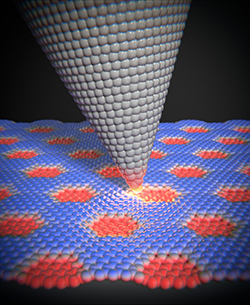
Previous studies have shown that a graphene ribbon can be moved across a gold surface with almost no friction. But if graphene is applied to a platinum surface, it has a significant impact on the measurable friction forces. Now, physicists from the University of Basel and Tel Aviv University have reported in the journal Nano Letters (“Velocity Dependence of Moiré Friction”) that, in this instance, the friction depends on the speed at which the tip of an atomic force microscope (AFM) is moved across the surface.
This finding is surprising because friction does not depend on speed according to Coulomb’s law, which applies in the macro world.
In conjunction with the platinum substrate, graphene no longer forms only the hexagonal honeycomb pattern of carbon atoms and instead forms superstructures known as Moiré superlattices. The surface is then no longer completely flat and exhibits a certain degree of roughness.
“If we move the AFM tip across this slightly corrugated surface at low speed, we measure a weak and almost constant frictional force,” explains Professor Ernst Meyer from the Swiss Nanoscience Institute and the Department of Physics at Basel University. “Above a certain threshold, however, the friction then increases with the speed of the AFM tip,” adds first author Dr. Yiming Song. “The larger the Moiré superstructure, the lower the threshold at which the friction becomes speed-dependent.”
The researchers found that there is greater resistance at the ridges of the Moiré superstructures during the movement of the tip. These ridges undergo elastic deformation due to the pushing tip before relaxing again when the pressure is sufficiently high. This effect results in greater frictional forces that increase with the speed of the tip. Simulations and an analytical model confirm the experimental findings obtained by this international team of researchers.
Image – The friction between the tip of an atomic force microscope and the Moiré superstructures depends on the speed at which the tip is moved across the surface. Courtesy of University of Basel.
************
For more information:
Augmented reality-enabled cold spray robot from AFRL wins defense tech award
The Air Force Research Laboratory and the Advanced Robotics for Manufacturing Institute won the Defense Manufacturing Technology Achievement Award for leading a development of a cold spray robot used in aerospace equipment refurbishment.
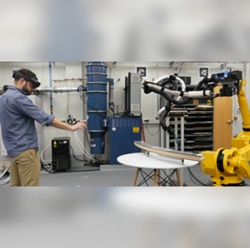
Dubbed ARRI, the augmented reality-enabled cold spray robot was created at AFRL’s Materials and Manufacturing Directorate. ARRI functions with the Microsoft Hololens virtual reality headset, which helps the human user control where a thermal coating should be applied on an aerospace workpiece undergoing rehabilitation.
In addition to funding from the laboratory, cost sharing agreements were signed with members of the ARM Institute as well as project integrators at the University of Connecticut and Titan Robotics to complete the project.
ARRI was installed in July at Warner Robins Air Logistics Complex, Robins Air Force Base in Georgia. WR-ALC invested $1.6 million to obtain two more ARRI-enabled controllers from Titan Robotics.
“The ARRI robot allows someone with no cold spray experience to be trained in about a day. The system also speeds up the time it takes to spray, reduces fixture costs, and improves capacity,” shared Shane Groves, robotics and automation expert at WR-ALC. He noted that the technology reduced training time by 90 percent and can save $600,000 in annual depot operating costs.
Image – Courtesy of: AFRL.
For more information:
Advanced Robotics for Manufacturing Institute
AFRL
Titan Robotics
University of Connecticut
A new era for metal powders
Metalysis, U.K., developed new complex metal powder alloys that offer significant material characteristics for the latest aerospace applications.
Continue readingA new robot system at the University of Stuttgart enables fully automated nondestructive testing
Two new research robots at the Institute of Polymer Technology at the University of Stuttgart, Germany, working autonomously and synchronously, are intended to optimize the testing technology for multifunctional high-performance materials.
Continue readingAJW Group and Safran sign service agreement for A320 and A330 landing gear components
AJW Group, U.K., selects Safran Landing Systems, France, to perform component repairs on landing gear, braking, and steering system equipment.
Continue readingSintx Technologies awarded multi-year DARPA contract to develop CMCs and high temperature coatings for turbine engines
Sintx Technologies, Inc., Salt Lake City, Utah, an original equipment manufacturer of advanced ceramics, received a three-year Phase II award of $1.5 million issued by DARPA to develop, design, and characterize thermal-environmental barrier coatings for functionally graded high temperature ceramic matrix composites.
Continue readingWinsert acquires Alloy Cast Products Inc.
Winsert, Marinette, Wisc., a global advanced manufacturer of critical metal parts for Fortune 500 OEMs and Tier 1 suppliers, acquired Alloy Cast Products Inc., an investment casting and machining manufacturer of exotic cobalt alloys headquartered in Kenilworth, New Jersey.
Continue reading