
Allium Engineering, Billerica, Mass., founded by two MIT PhDs, is tripling the lifetime of bridges and other structures with a new technology that uses a stainless steel cladding to make rebar resilient to corrosion.
Continue reading

Allium Engineering, Billerica, Mass., founded by two MIT PhDs, is tripling the lifetime of bridges and other structures with a new technology that uses a stainless steel cladding to make rebar resilient to corrosion.
Continue reading
Siemens, Germany, opened its $190 million electrical equipment manufacturing facility in Fort Worth, Texas. A part of the company’s Smart Infrastructure business, the site is responsible for creating reliable and efficient electrical equipment such as low-voltage switchboards necessary to meet the demand from the booming data center market and America’s AI growth.
The 500,000-square-foot facility has already introduced 480 new jobs and is on track to add a total of 800 roles by 2026. Tapping talent from the education sector to develop the critical manufacturing workforce of tomorrow, previous schoolteachers and principals are critical to Fort Worth facility’s employee training team. Their unique skillset has helped create curriculum that better serves different learning styles with innovative methods for both in and outside the classroom – resulting in quicker turnaround time of new employees from the classroom to the shop floor. Siemens brings new employees from the classroom through to a physical-learning lab before placing them on the production floor.
“Texas is the epicenter of innovation, where businesses and entrepreneurs can cast a vision and know they live in a state where they can achieve it,” said Governor Greg Abbott. “Siemens’ $190 million investment in an electrical equipment manufacturing facility in Fort Worth will create jobs for 800 Texans and help build critical infrastructure to meet Texas’ growing data center demand. Siemens will also provide critical job training to prepare Texans for these in-demand, good-paying jobs. By working together with companies like Siemens, Texas will continue to lead the world in manufacturing and innovation as we build a stronger, more prosperous state.”
Meeting Siemens’ goal to maintain assets that are net-zero carbon in operation by 2030, the Fort Worth facility is carbon-neutral and is setting the standard for sustainable manufacturing. Featuring an all-electrical powder-coat paint line, electric forklifts, low-energy-consuming HVAC systems, photovoltaic streetlights, advanced energy monitoring, and Breakthrough Energy-backed energy-efficient LuxWall windows, the Fort Worth facility is an archetype for the future of manufacturing – lowering cost and energy usage wherever possible.
Showcasing the future of industrial automation, the facility team utilized Siemens’ Digital Industries Software to optimize the production flow. Siemens Technomatix’s 3D models were used to simulate, validate, and commission the production process so the shop floor could be designed for higher production quality.
For more information:
Siemens Corporation

Researchers from the University of Illinois Urbana-Champaign, in collaboration with Sandia National Laboratories and Bucknell University, have found that insight from muscovite mica and earthquake statistics can help quantify how hostile environmental interactions impact the degradation of materials used in advanced solar panels, geological carbon sequestration, and infrastructure.
Continue reading
Most fluidized-bed furnaces are used at temperatures below 1095 °C (2000 °F), although some manufacturers have furnaces capable of treating components to temperatures through 1205 °C (2200 °F). Initially, the gas flows upward through the permeable base to agitate the particles as the pressure is gradually increased. (b) Eventually, the gas flow is sufficient to lift the small particles of refractory materials and to transform the particle movement into a violent turbulent motion.
In the early 1980s, this furnace technology seemed to be on the right track as an alternative to salt bath technology, showing similar advantages and applications but without the environmental hazard of salt compounds, waste disposal, recycling of salts, and so on. Nowadays it can be concluded that salt bath technology was partially substituted by vacuum technology, but especially for bainitic hardening (austempering processes), salt baths are still commonly used and show a slightly growing tendency, whereas fluidized beds are hardly used any more.
This temperature limitation is related to the wear and tear on the retort materials at high temperatures, which was one of the reasons for the reduced interest in this furnace type after the initial hype.
For more information, click on the link below (subscription required). Then scroll to Figure 8.
R Schneider; R. Mesquita; W Schützenhöfer, Distortion in Tool Steels, ASM International, 2014, https://doi.org/10.31399/asm.hb.v04d.a0005958
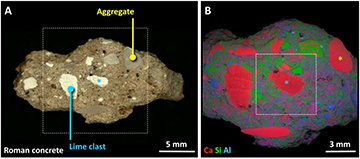 Researchers have spent decades trying to figure out the secret of Rome’s ultradurable ancient construction material, used in the famed Pantheon as well as aqueducts and seawalls that endured especially harsh environmental conditions. Now, a team of investigators from MIT, Harvard University, and laboratories in Italy and Switzerland, has made progress in this field, discovering ancient concrete-manufacturing strategies that incorporated several key self-healing functionalities.
For many years, researchers have assumed that the key to the ancient concrete’s durability was based on one ingredient: pozzolanic material such as volcanic ash from the area of Pozzuoli, on the Bay of Naples. This specific kind of ash was even shipped all across the vast Roman empire to be used in construction, and was described as a key ingredient for concrete in accounts by architects and historians at the time.
Under closer examination, these ancient samples also contain small, distinctive, millimeter-scale bright white mineral features, which have been long recognized as a ubiquitous component of Roman concretes. These white chunks, often referred to as “lime clasts,” originate from lime, another key component of the ancient concrete mix.
Upon further characterization of these lime clasts, using high-resolution multiscale imaging and chemical mapping techniques pioneered in Professor Admir Masic’s research lab at MIT, the researchers gained new insights into the potential functionality of these lime clasts.
Studying samples of this ancient concrete, he and his team determined that the white inclusions were made out of various forms of calcium carbonate. And spectroscopic examination provided clues that these had been formed at extreme temperatures, as would be expected from the exothermic reaction produced by using quicklime instead of, or in addition to, the slaked lime in the mixture. Hot mixing, the team has now concluded, was actually the key to the super-durable nature.
During the hot mixing process, the lime clasts develop a characteristically brittle nanoparticulate architecture, creating an easily fractured and reactive calcium source, which, as the team proposed, could provide a critical self-healing functionality. As soon as tiny cracks start to form within the concrete, they can preferentially travel through the high-surface-area lime clasts. This material can then react with water, creating a calcium-saturated solution, which can recrystallize as calcium carbonate and quickly fill the crack, or react with pozzolanic materials to further strengthen the composite material. These reactions take place spontaneously and therefore automatically heal the cracks before they spread. Previous support for this hypothesis was found through the examination of other Roman concrete samples that exhibited calcite-filled cracks.
To prove that this was indeed the mechanism responsible for the durability of the Roman concrete, the team produced samples of hot-mixed concrete that incorporated both ancient and modern formulations, deliberately cracked them, and then ran water through the cracks. Sure enough: Within two weeks the cracks had completely healed and the water could no longer flow. An identical chunk of concrete made without quicklime never healed, and the water just kept flowing through the sample. As a result of these successful tests, the team is working to commercialize this modified cement material.
Through the extended functional lifespan and the development of lighter-weight concrete forms, Masic hopes that these efforts could help reduce the environmental impact of cement production, which currently accounts for about 8% of global greenhouse gas emissions. Along with other new formulations, such as concrete that can actually absorb carbon dioxide from the air, another current research focus of the Masic lab, these improvements could help to reduce concrete’s global impact.
Image – Compositional and morphological characterization of ancient and modern lime clasts. (a) Optical micrographs showing the conspicuous bright white color of the lime clasts, which can easily be identified from large-area elemental mapping via SEM-EDS (b). Courtesy of Science Advances (2023). DOI: 10.1126/sciadv.add1602.
************
For more information:
 SPEE3D, Australia, announced its WarpSPEE3D printer will be hosted at Nupress headquarters in Australia. Meaning local Australian manufacturers and businesses will be able to access the machine through a subscription without having to lease or purchase it.
This unique subscription model will provide Nupress’s existing clients in the mining, building, aerospace, defense, and medical industries, and other Australian manufacturers’ access to SPEE3D’s patented cold-spray technology. It will provide them the opportunity to source parts locally and quickly from a selection of 12 different metals.
Nupress is a leading manufacturer of precision machined components and assemblies with over 50 years of expertise. Together with SPEE3D, the game-changing subscription service will enable Nupress clients and other Australian manufactures to produce parts at the time of need, rather than waiting weeks or months via other supply chains. Because metal parts can now be sourced locally, this will help manufacturing companies improve their operations and reduce costs – many of which have been impacted negatively due to ongoing global supply chain issues. The subscription model offers one to six slots, each delivering 25 hours per month of printing for 12 months.
“Democratizing access to SPEE3D’s WarpSPEED printer will help solve real-world problems around broken supply chains, manufacturing challenges, and massive delays for some of the world’s most significant industries. Local Australian companies can now access our technology thanks to Nupress, enabling smaller production runs, prototyping needs, material developments, and other advanced manufacturing capabilities,” said Steven Camilleri, Co-Founder, and CTO of SPEE3D.
Image – WarpSPEE3D, the technology that will be available at Nupress on a subscription-based service for local Australian organizations.
For more information:
Nupress
SPEE3D