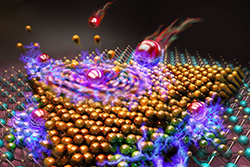
In experiments conducted at TU Wien, Vienna, extremely small pieces of gold, consisting of a few thousand atoms and with a diameter in the order of ten nanometers, are bombarded with highly charged ions. This makes it possible to change the shape and size of these gold pieces in a targeted manner. The effects of the ion bombardment were then studied in an atomic force microscope with surprising results.
“We work with multiply-ionized xenon atoms. Up to 40 electrons are removed from these atoms, so they are highly electrically charged,” says Prof. Richard Wilhelm from the Institute of Applied Physics at TU Wien. These highly charged ions then hit small gold islands placed on an insulating substrate—and then different things can happen: The gold islands may become flatter, they can melt, they can even evaporate. “Depending on how highly our ions are electrically charged, we can trigger different effects,” says Gabriel Szabo, first author of the current study (Small, “Charge-State-Enhanced Ion Sputtering of Metallic Gold Nanoislands”).
The highly charged ions hit the tiny gold nuggets at elevated speed—at around 500 kilometers per second. Nevertheless, it is remarkably not the force of the impact that changes the gold islands. The process is completely different from the impact of a golf ball in a pile of sand, or the accidental impact of a tennis ball in a nicely decorated birthday cake.
“If you shoot uncharged xenon atoms at the gold islands with the same kinetic energy, the gold islands remain practically unchanged,” says Gabriel Szabo. “So the decisive factor is not the kinetic energy, but the electrical charge of the ions. This charge also carries energy, and it is deposited exactly at the point of impact.”
As soon as the extremely strongly positively charged ions hit the nano gold piece, they snatch electrons away from the gold. In a large piece of gold, this would have no significant effect: Gold is an excellent conductor, the electrons can move freely, and more electrons would be supplied from other areas of the gold nugget. But the nano-gold structures are so small that they can no longer be regarded as an inexhaustible reservoir of electrons. It is precisely here that one enters the intermediate world between macroscopic metal and tiny atomic clusters and their nanoscale properties.
“The charge energy of the impacting ion is transferred to the gold, thus the electronic structure of the entire nano-gold object is thrown completely out of balance, the atoms start to move and the crystal structure of the gold is destroyed,” explains Richard Wilhelm. “Depending on how much energy you deposit, it may even happen that the entire nano-gold piece melts or is vaporized.”
The effects of the ion bombardment can then be studied in an atomic force microscope: Depending on the charge of the ions, the height of the gold pieces is reduced to a lesser or greater extent, Gabriel Szabo reports: “Just as our models had also predicted, we can control the impact of the ions on the gold – and not by the speed we give our projectiles, but rather by their charge.” Improved control and deeper understanding of such processes is important for making a wide variety of nanostructures.
Image – Highly charged ions hit tiny gold nuggets on an insulating surface. Courtesy of ucyborg.com/studio.
************
For more information:
TU Vienna