New research shows that diamond—although known for being the best natural heat conductor on Earth—at the atomic scale it can briefly trap heat in unexpected ways. The findings could influence how scientists design diamond-based quantum technologies, including ultra-precise sensors and future quantum computers.
Researchers from University of Warwick, along with their collaborators, showed that when certain molecular-scale defects in diamond are excited with light, they create tiny, short-lived “hot spots” that momentarily distort the surrounding crystal. These distortions last only a few trillionths of a second but are long enough to affect the behavior of quantum-relevant defects.
“Finding a hot ground state for a molecular-scale defect in diamond was extremely surprising for us”, explained Professor James Lloyd-Hughes, Department of Physics, University of Warwick. “Diamond is the best thermal conductor, so one would expect energy transport to prevent any such effect. However, at the nanoscale some phonons—packets of vibrational energy—hang around near defect, creating a miniature hot environment that pushes on the defect itself.”
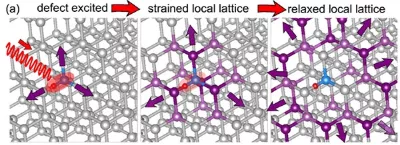
The team studied a specific atomic defect in diamond where a nitrogen atom sits in place of a carbon atom and bonds to hydrogen—known as the Ns:H-C0 defect. When the researchers excited the defect’s C–H bond with ultrafast infrared laser pulses, they expected the heat to dissipate immediately into the diamond lattice.
Instead, advanced spectroscopy revealed a curious effect: the defect briefly entered what scientists call a ‘hot ground state’—meaning the surrounding crystal was still hot, and the defect was altered. The presence of built-up vibrational energy nearby shifted the defect’s infrared signature to a higher energy, taking a few picoseconds to peak and then decay.
Dr. Junn Keat, PDRA, Department of Physics, University of Oxford and former PhD student at Warwick said: “For this study we used multidimensional coherent spectroscopy (2DIR) to study the defect, which allows us to separate the response of the defect produced by light with different energies.
The new findings indicate that optical techniques used to control defects may unintentionally generate small, short-lived pockets of heat. These local temperature spikes can subtly disturb the spin states, potentially affecting coherence times and the overall performance of diamond-based quantum devices.
Image – Excitation and relaxation of the Ns:H−C0 defect in a diamond crystal. Gray, blue, and red spheres represent carbon, nitrogen, and hydrogen atoms, respectively. Purple arrows show the transfer of energy away from the defect. Courtesy of Physical Review Letters.
************
For more information:
University of Warwick