
NASA officials recently unveiled a powdery material—from pieces of the asteroid Bennu—that looked like asphalt or charcoal, but was easily worth more than its weight in diamonds. The fragments were collected and returned to Earth for materials analysis by the OSIRIS-REx mission. Early evaluations using electron microscopy revealed high carbon content.
The samples hold chemical clues to the formation of our solar system and the origin of life-supporting water on our planet. The clay and minerals from the 4.5 billion-year-old rock had been preserved in space’s deep freeze since the dawn of the solar system. Last month, after a seven-year-long space mission, they parachuted to a desert in Utah, where they were whisked away by helicopter.
And now those pristine materials sit in an airtight vessel in a clean room at NASA’s Johnson Space Center, where researchers like University of Arizona planetary scientist Dante Lauretta are getting their first chance to study the sample up close.
The electron microscopes were fired up and ready” by September 27, Lauretta said in a news conference. “And boy did we really nail it.” (Lauretta, the principal investigator, gave the mission its name, which stands for Origins, Spectral Interpretation, Resource Identification, Security-Regolith Explorer.) The preliminary investigation of a tiny fraction of the sample revealed it is rich in water, carbon, and organic compounds.
Carbon is essential for all living things on Earth, forming chemical bonds with hydrogen, oxygen, and other elements necessary to build proteins and enzymes. “We’re looking at the kinds of minerals that may have played essential roles in the origin of life on Earth,” Lauretta said.
The Bennu sample contained about 4.7 percent carbon, as measured by the Carnegie Institution for Science, according to Daniel Glavin, the OSIRIS-REx sample analysis lead at NASA’s Goddard Space Flight Center. This is “the highest abundance of carbon” the Carnegie team has measured in an extraterrestrial sample, Glavin said. “There were scientists on the team going ‘Wow, oh my God!’ And when a scientist says that ‘Wow;’ that’s a big deal.”
The Bennu sample is also flush with organic compounds, too, which glowed like tiny stars within the dark sample when exposed to a black light. “We picked the right asteroid—and not only that, we brought back the right sample,” Glavin said. “This stuff is an astrobiologist’s dream.”
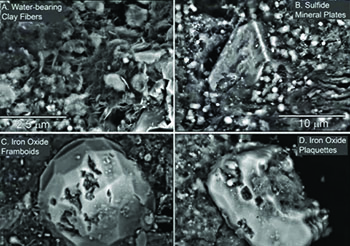
Asteroids like Bennu were most likely responsible for all of Earth’s wet features—the water in oceans, lakes, rivers, and rain probably arrived when space rocks landed on our young planet some 4 billion years ago. Bennu has water-bearing clay with a fibrous structure, which according to Lauretta, was the key material that ferried H2O to Earth.
Under magnification, the clay has a sinuous shape. “We call this serpentine because they look like serpents or snakes inside the sample, and they have water locked inside their crystal structure,” he said. “That is how we think water got to the Earth.”
This is only the start. The OSIRIS-REx science team, as they catalog the sample, have months of more detailed work ahead. After six months, they will publish the catalog; scientists from around the world will be able to propose studies using the materials—though more than half the sample will be kept in reserve for research to take place years or even decades in the future.
Image – A scanning electron microscope view of the minerals in the Bennu sample; Fig. A shows the snake-shaped clay that contains water. Courtesy of NASA livestream.
************
For more information:
NASA